WA7BNM Contest Calendar – 0900Z-1500Z, Jun 17
from rssfeedtop10 https://ift.tt/2sMUWnL
via IFTTT

 Posts
All Comments
Posts
All Comments
WA7BNM Contest Calendar – 0900Z-1500Z, Jun 17
from rssfeedtop10 https://ift.tt/2sMUWnL
via IFTTT
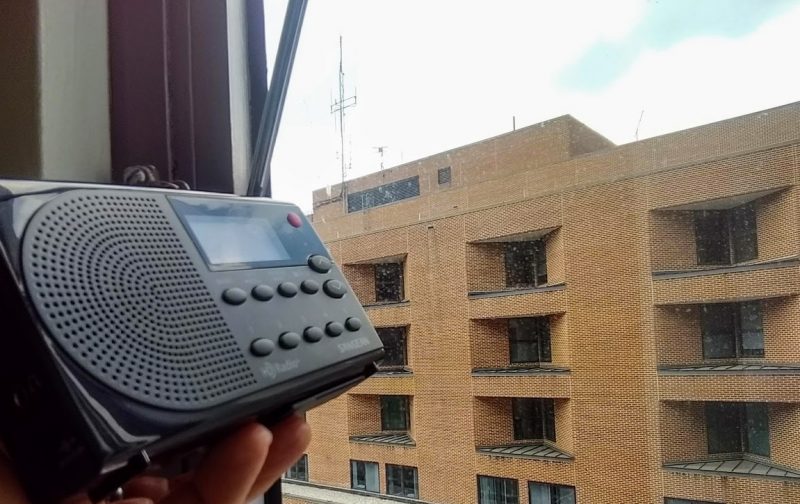
The Sangean HDR-14 AM/FM HD radio
For the past week, I’ve been away from home spending time with my mother at the hospital while she recovers from a surgery. I’ve got a number of reviews and evaluations in the pipeline, but thankfully no shortwave or HF radios on the table this week (although the ELAD FDM-S3 and CommRadio CTX-10 are just around the corner). Listening to shortwave (or even mediumwave) in a hospital room can be an exercise in futility–there are just too many devices emitting noise and the buildings are built like bunkers with incredibly thick walls to attenuate signals.
I’ve had the little Sangean HDR-14 with me, however, and have been very pleased with its ability to snag FM stations both analog and digital. I’ve also had fun discovering a surprisingly diverse FM landscape in this metro area. I haven’t snagged an AM HD station yet, but my hope is one evening I might DX one (fingers crossed and not holding my breath).

The Sangean HDR-14 (left) and CC Skywave SSB (right)
At the end of most days, I’ve been able to catch a little shortwave action with my CC Skywave SSB (pre-production) portable at the guest house where I’m staying. The evenings have been surprisingly peaceful here with only the occasional popup thunderstorm to insert a little QRN in my listening sessions.
 Last night, while listening to jazz on FM, I finished reading All The Light We Cannot See by Anthony Doerr (affiliate link).
We’ve mentioned this book before and I know of at least dozen SWLing Post contributors and friends who’ve personally recommended it to me.
It is a superb novel and will, no doubt, tug at the heart strings of any radio enthusiast or WWII history buff. Highly recommended!
Indeed, last night I couldn’t fall asleep until I finished the book around 12:30 AM!
And mom? She’s recovering quite well and we hope will be discharged from the hospital soon.
from rssfeedtop10 https://ift.tt/2sLpXbY
via IFTTT
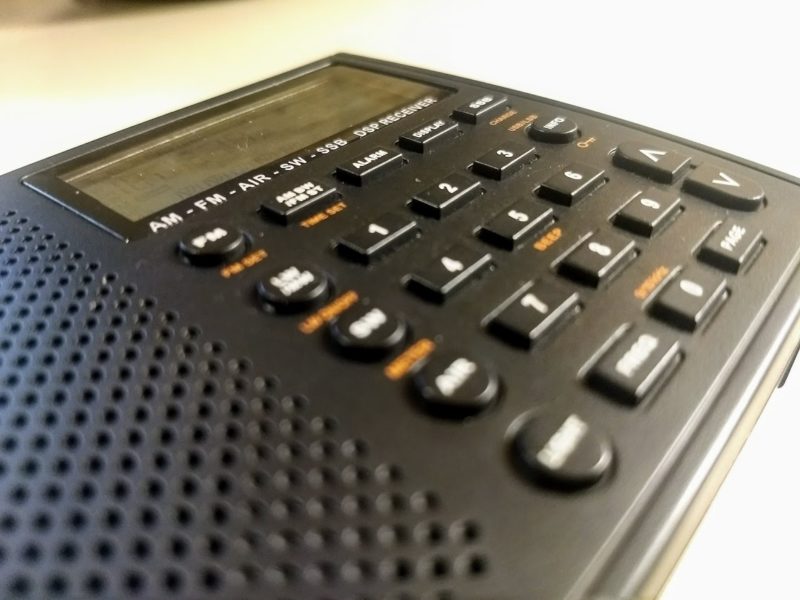
Many thanks to SWLing Post contributor, London Shortwave, for sharing the following Have Your Say review of Australian Broadcasting Services in the Asia Pacific:
Review of Australian Broadcasting Services in the Asia Pacific – Terms of Reference
The Government is undertaking a review of Australian media services in the Asia Pacific, including the role of shortwave radio. The review is being conducted jointly by the Department of Communications and the Arts and the Department of Foreign Affairs and Trade.
Purpose
The objective of the review is to assess the reach of Australia’s media in the Asia Pacific region, including examining whether shortwave radio technology should be used.
Scope
The review will analyse the:
- coverage and access of existing Australian media services in the Asia Pacific region; and
- use and value of Australian shortwave technology in the Asia Pacific region.The review will cover:
- all media distribution platforms (i.e. television, radio and online);
- commercial, community and publicly funded services; and
- different types of technologies such as analogue, digital and satellite radio and television services and online services.
Have your say
Interested stakeholders in Australia and overseas are encouraged to contribute to this review. Submissions on any aspect of the review should be uploaded to the review website by 3 August 2018.
Timeframe
The review is expected to report to the Government in 2018.
Background
In September 2017 the Government agreed to conduct a review of Asia Pacific Broadcasting Services as follows:
“The Department of Communications and the Arts and the Department of Foreign Affairs and Trade will conduct a review into the reach of Australian broadcasting services in the Asia Pacific region, including examining whether shortwave radio technology should be used. The review will include public consultation and the report of the review will be made public.”
Consultation Period:
June 04, 2018 09:00 AEST to August 03, 2018 17:00 AESTThe Australian Broadcasting Corporation ceased shortwave broadcasting in the Asia-Pacific region in January 2017 ahead of a transition to FM transmission.
The review is assessing the reach of Australia’s media in the Asia-Pacific region, including examining whether shortwave radio technology should be used.
All media distribution platforms – television, radio and online – are being examined including commercial, community and publicly funded services.
The review is also looking at different types of technologies such as analogue, digital and satellite radio and television services and online services.
Click here to view this information and participate via the Have Your Say website.
from rssfeedtop10 https://ift.tt/2l2EITw
via IFTTT
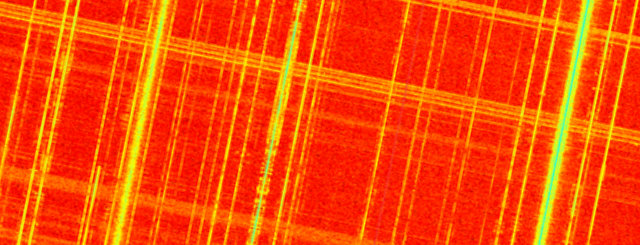
Last month, we posted a link to an article that explained why traders might use shortwave radio for high-speed, faster-than-optical-fiber communications. The article by Bob Van Valzah originally appeared on the blog, Sniper in Mahwah & Friends where they’ve just posted part two in the series:
I have previously claimed that trading over shortwave radio is real and presented the story of the first evidence I found of it. It was pleasantly surprising to see the story picked up by IEEE Spectrum, Hacker News, Hackaday, and others. But since I hadn’t anticipated such a diverse audience, I didn’t provide details needed to understand shortwave trading in context so a lot of questions were raised. I’ll provide some background here, answer the questions, and also document two other shortwave trading sites I’ve found around Chicago. Traders can skip ahead while I fill in the broader audience.
Why is there a latency race? Isn’t it just a waste of money?
Electronic trading technologist just take the latency race for granted, but it’s important to think about why it exists and what it means to the average person. When you want to fill your car with gasoline, you have the choice of going to the nearby gas station and accepting their price or perhaps comparing prices at stations a little farther away. We would all spend a lot more time comparison shopping if we didn’t have pretty good confidence that the prices at our local stations were competitive. But what keeps those prices competitive?
The analogy between your local gas station and electronic markets is admittedly imperfect, but I think it is helpful in understanding why latency matters and how you benefit. Nobody can buy a tanker of gasoline in New York and immediately sell it in Chicago. The laws of physics prevent us from economically moving such a heavy load over a long distance quickly. But a share of Apple stock weighs nothing. The Chicago price and the New York price can be compared and changed in an instant. Well, about 4 milliseconds is how long it takes for an updated price to make the trip. Prices can make about 250 one-way trips in a single second.
So when buying or selling Apple shares, you don’t have to shop around for the best price. Electronic trading companies have an incentive to build the fastest networks linking financial centers so that prices can move quickly between them. Buyers and sellers benefit because their local market has electronic traders who know the best prices on other markets and will be happy to do a local deal at the best global price (it’s market making). It doesn’t take a rocket surgeon to see the business opportunity in this type of trading, so high-speed traders have to be efficient because they’re competing against each other. The latency race has to happen for each market to have the best price. Competition between electronic traders limits their spend to the benefits that come with better pricing.
Why does radio help win the latency race?
Traders use radio because it can move prices faster than optical fiber.
I won’t bore you with the physics, but I will remind you of this elementary school experiment where a pencil appears to bend in a glass of water. This happens because light moves more quickly through air than it does through water. In the same way, radio waves move more quickly through air than light can move through an optical fiber. In trading parlance, radio is lower latency than fiber over a given distance.
But radio is also faster because it almost always covers a shorter distance. Fiber paths tend to follow roads and property lines that may not go exactly in the desired direction. Radio towers may be inconvenient, but they give the advantage that the signal can take the shortest-possible path allowed by physics, not the kinky path dictated by rights of way.[…]
Continue reading the full article on the blog, Sniper in Mahwah & Friends.
from rssfeedtop10 https://ift.tt/2xYjcbM
via IFTTT