

eHam.net News – “Microphones” is the topic of the current (April 12) episode of the
“ARRL The Doctor is In” podcast.
Listen…and learn!
from topfeedremix https://ift.tt/2Jagb8O
via IFTTT

 Posts
All Comments
Posts
All Comments
eHam.net News – “Microphones” is the topic of the current (April 12) episode of the
“ARRL The Doctor is In” podcast.
Listen…and learn!
from topfeedremix https://ift.tt/2Jagb8O
via IFTTT
eHam.net News – “Microphones” is the topic of the current (April 12) episode of the
“ARRL The Doctor is In” podcast.
Listen…and learn!
from topfeedremix https://ift.tt/2Jagb8O
via IFTTT

I’ve been helping a friend’s daughter study for her Technician Amateur Radio License. Besides my tutoring, she’s only been studying with a free phone app thus far and essentially learning the answers to the questions. I know she really needs a book that can provide context for each question.
Since there was no need to buy a new $30 guide (that’s only valid until the end of June), I started my search on Amazon.com thinking that there may be some affordable, good condition used study guides I could snag for a decent price.
I was wrong.
Check out the screenshot below from this page:
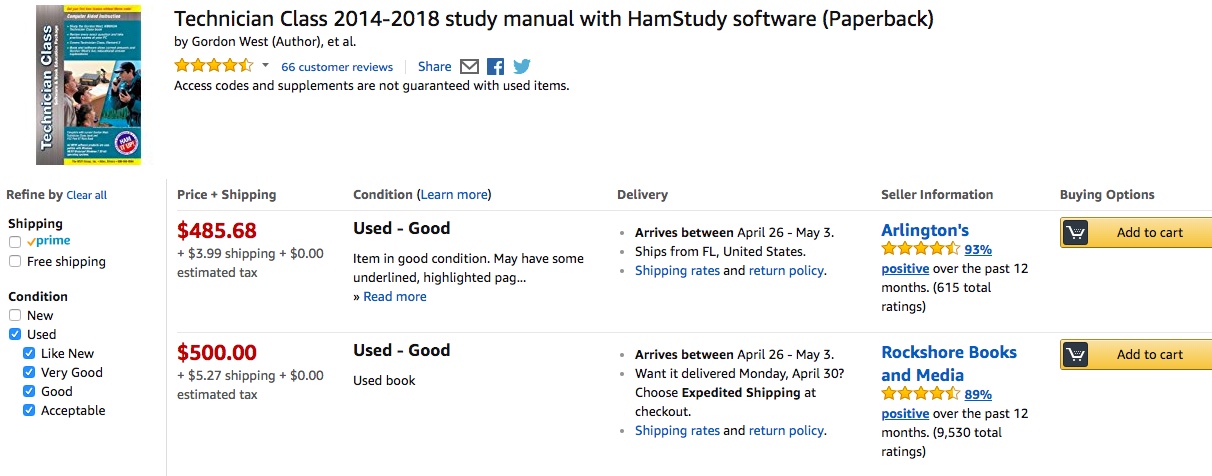
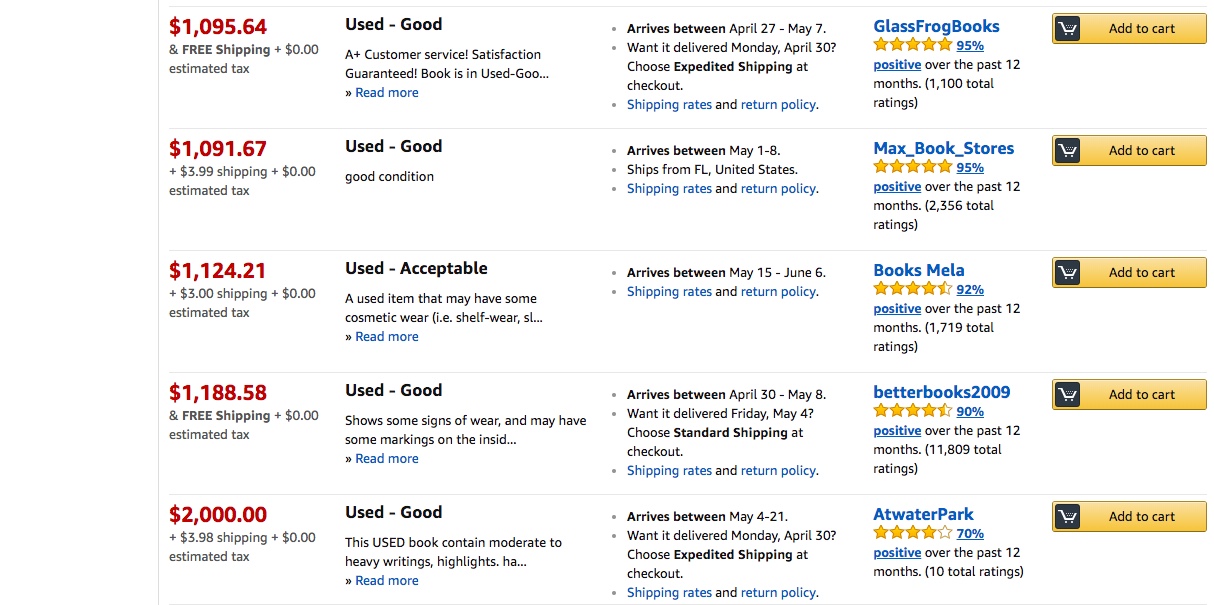 And if $2,000 US (plus $3.95 shipping!) wasn’t too high…
 $4,093 (plus $3.95 shipping!) for a used “Acceptable” condition Technician License Study Guide?!? What a deal! Is there a limit on how many I can buy?
I’ve heard that some sellers add high prices to items that they want to put on “hold.” I did some searching this afternoon and saw discussions by sellers admitting that this technique saves them time from relisting an item that might need more research. More than one admitted that “And hey, if someone buys it for that price, all the better!”
Personally, I think this practice should be banned by Amazon. I checked out one of the stores from a seller in the list above and almost all of their listings have astronomical prices.
What do you think? Am I the only one noticing this trend?
from topfeedremix https://ift.tt/2J9YxlF
via IFTTT
NEWS UPDATE – “I arrived in Tuvalu on the 14th but due to work-QRL, rainy WX and unavailability of assistance to erect antennas, only limited operation was possible until now. It is hoped that by this evening better antennas will be up, and also more on-air time available with QRO power. Conditions are excellent to EU […]
from topfeedremix https://ift.tt/2yiUiBQ
via IFTTT
The winning article for the April 2018 QST Cover Plaque award is “An Ultra Simple 2-Meter Antenna” by John Portune, W6NBC. The QST Cover Plaque Award — given to the author or authors of the most popular article in each issue — is determined by a vote of ARRL members on the QST Cover Plaque Poll web page. Cast a ballot for your favorite article in the May issue today.
from topfeedremix https://ift.tt/2HbOEYh
via IFTTT
ARRL –
The winning article for the April 2018 QST Cover Plaque award is “An Ultra Simple 2-Meter Antenna” by John Portune, W6NBC. The QST Cover Plaque Award — given to the author or authors of the most popular article in each issue — is determined by a vote of ARRL members on the QST Cover Plaque Poll web page. Cast a ballot for your favorite article in the May issue today.
from topfeedremix https://ift.tt/2HbOEYh
via IFTTT
Special Canadian call sign VB18FIFA will be among those active around the world from June 1 to July 15 for a World Cup 2018 football Amateur Radio “marathon.” The event will be held during the 2018 FIFA World Cup in Russia. Russia’s IARU member-society SRR is encouraging Amateur Radio organizations to field World-Cup-related call signs, preferably with “FIFA” (or “FWC” for finalist countries) a…
from topfeedremix https://ift.tt/2Jbph5j
via IFTTT
ARRL –
Special Canadian call sign VB18FIFA will be among those active around the world from June 1 to July 15 for a World Cup 2018 football Amateur Radio “marathon.” The event will be held during the 2018 FIFA World Cup in Russia. Russia’s IARU member-society SRR is encouraging Amateur Radio organizations to field World-Cup-related call signs, preferably with “FIFA” (or “FWC” for finalist countries) a…
from topfeedremix https://ift.tt/2Jbph5j
via IFTTT
European Space Agency Astronaut Alexander Gerst, KF5ONO, will visit the International Space Station for the second time in early June. His “Horizons” mission is aimed at evoking exploration of the universe, looking far beyond Earth and broadening knowledge. His first mission was called “Blue Dot.”
A citizen of Germany, Gerst will launch on June 6 from Kazakhstan with US astronaut Serena Auñón-C…
from topfeedremix https://ift.tt/2F0hIMu
via IFTTT
DK7KF and DM1AC will be active as PJ6E, from Saba Island, IOTA NA – 145, 18 – 28 April 2018.
from topfeedremix https://ift.tt/2qIQpBJ
via IFTTT
Here’s the very latest FREE (non-subscription) DX-World Weekly Bulletin written by Bjorn, ON9CFG. As always it’s packed full of info and this week runs to 13 pages. You can download it here
from topfeedremix https://ift.tt/2Hc4kL4
via IFTTT
“Microphones” is the topic of the current (April 12) episode of the “ARRL The Doctor is In” podcast. Listen…and learn!
Sponsored by DX Engineering, “ARRL The Doctor is In” is an informative discussion of all things technical. Listen on your computer, tablet, or smartphone — whenever and wherever you like!
Every 2 weeks, your host, QST Editor-in-Chief Steve Ford, WB8IMY, and the Doctor himself,…
from topfeedremix https://ift.tt/2HbtE3O
via IFTTT
ARRL –
“Microphones” is the topic of the current (April 12) episode of the “ARRL The Doctor is In” podcast. Listen…and learn!
Sponsored by DX Engineering, “ARRL The Doctor is In” is an informative discussion of all things technical. Listen on your computer, tablet, or smartphone — whenever and wherever you like!
Every 2 weeks, your host, QST Editor-in-Chief Steve Ford, WB8IMY, and the Doctor himself,…
from topfeedremix https://ift.tt/2HbtE3O
via IFTTT
ARRL –
“Microphones” is the topic of the current (April 12) episode of the “ARRL The Doctor is In” podcast. Listen…and learn!
Sponsored by DX Engineering, “ARRL The Doctor is In” is an informative discussion of all things technical. Listen on your computer, tablet, or smartphone — whenever and wherever you like!
Every 2 weeks, your host, QST Editor-in-Chief Steve Ford, WB8IMY, and the Doctor himself,…
from topfeedremix https://ift.tt/2HbtE3O
via IFTTT
ARRL –
“Microphones” is the topic of the current (April 12) episode of the “ARRL The Doctor is In” podcast. Listen…and learn!
Sponsored by DX Engineering, “ARRL The Doctor is In” is an informative discussion of all things technical. Listen on your computer, tablet, or smartphone — whenever and wherever you like!
Every 2 weeks, your host, QST Editor-in-Chief Steve Ford, WB8IMY, and the Doctor himself,…
from topfeedremix https://ift.tt/2HbtE3O
via IFTTT
ARRL –
“Microphones” is the topic of the current (April 12) episode of the “ARRL The Doctor is In” podcast. Listen…and learn!
Sponsored by DX Engineering, “ARRL The Doctor is In” is an informative discussion of all things technical. Listen on your computer, tablet, or smartphone — whenever and wherever you like!
Every 2 weeks, your host, QST Editor-in-Chief Steve Ford, WB8IMY, and the Doctor himself,…
from topfeedremix https://ift.tt/2HbtE3O
via IFTTT
ARRL –
“Microphones” is the topic of the current (April 12) episode of the “ARRL The Doctor is In” podcast. Listen…and learn!
Sponsored by DX Engineering, “ARRL The Doctor is In” is an informative discussion of all things technical. Listen on your computer, tablet, or smartphone — whenever and wherever you like!
Every 2 weeks, your host, QST Editor-in-Chief Steve Ford, WB8IMY, and the Doctor himself,…
from topfeedremix https://ift.tt/2HbtE3O
via IFTTT
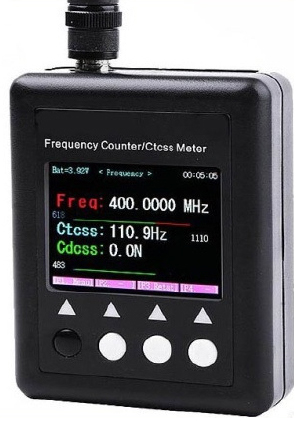
Many thanks to SWLing Post contributor, Mario Filippi (N2HUN), for sharing the following guest post:
by Mario Filippi (N2HUN)
All photos courtesy of author
Most hobbyists own some type of transceiver whether it is a handheld, mobile, or base station. Some examples are amateur radio HF/VHF/UHF transceivers, Citizen’s Band radios, FRS (Family Radio Service) and GMRS (General Mobile Radio Service) handhelds.
A useful tool for the shack or the field is a frequency counter/tone meter since it can measure frequencies and analog/digital tones from transmitters/transceivers. At times ascertaining that a UUT (Unit Under Test) such as a 2 meter handheld is transmitting accurately may be indicated due to problems communicating with other stations. In addition, if the UUT transmits a sub-audible tone (either analog or digital) to access a repeater, a frequency counter/tone meter can detect the presence and verify accuracy of the CTCSS/digital tone.
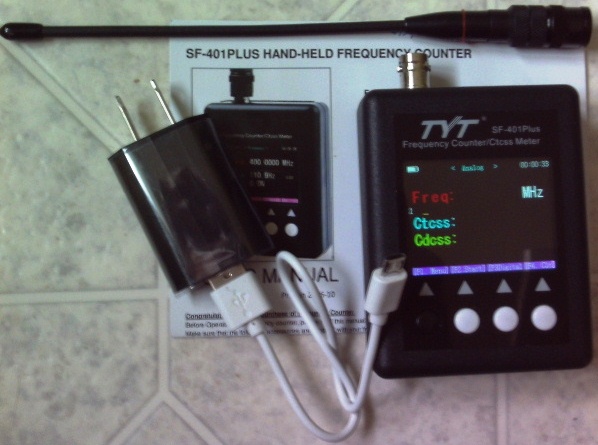
Author’s TYT SF-401Plus, includes instructions, antenna, rechargeable battery and charger/cable. Covers 27 MHz – 3 GHz
Frequency/tone meters can be purchased for less than twenty US dollars but normally do not include a rechargeable battery and BNC connector for attaching an external antenna. Having had experience with these types, the time finally came for an upgrade.
After shopping around a decision was made to purchase the Tytera TYT SF-401 Plus. This model includes an instruction sheet, antenna, internal rechargeable battery, USB charger and cable. It represents a significant improvement over my previous, inexpensive meter, as the TYT has a BNC connector to attach a larger antenna and has four control buttons on the front panel. It also has, via a system menu, options to adjust the frequency/tone offset, dimmer levels, three or four decimal display and auto power off. All these valuable features warrant a higher cost, which was about $50, but well worth it. This price fits the budget of most hobbyists. However, higher end frequency/tone meters are available and cost several hundred dollars for those requiring that level of quality.
Out of the box the TYT SF-401 Plus, when checked against an IFR FM/AM-500A communications service monitor, was right on the money as far as accuracy. Note that the IFR-500A was calibrated against a high precision internal 10 MHz crystal in an “oven” and this is my gold standard reference for frequency accuracy in my shack.

TYT accuracy checked against an IFR FM/AM-500A communications service monitor transmitting a 146.52 MHz/131.8 Hz tone. Note frequency readout to four decimal places.
Now, it was time to check typical radios around the shack using the TYT. The first radio tested for frequency accuracy was a BTECH GMRS-V1 HT which I use to communicate with the home QTH while running errands around town. See photo for results. The BTECH and TYT agreed perfectly. Note that the TYT’s display includes a battery status indicator on top left and a timer use indicator, which resets every time the TYT is turned on. If you are going to measure digital signals (not included in this review) there is an option in the Setup Menu for that. With the BTECH handheld running 2 watts the TYT could detect its’ frequency at roughly four feet away.

Confirming BTECH transmit frequency against the TYT. Output is 2 watts. TYT multicolor display is super.
For VHF/UHF operating, especially when afield with other hams or groups such as CERT (Community Emergency Response Teams), problems can ensue if one does not have the correct frequency or tone programmed, so having the TYT in your shirt pocket to confirm these parameters when trouble occurs can be a quick way to get to the problem. See photo of an Icom IC-2300H 2 meter transceiver checked against the TYT for proper offset and tone. The Icom was putting out 65 watts and a repeater with an offset of -1.3 MHz and 88.5 Hz tone was checked.

TYT confirming unusual offset (-1.3 MHz) and tone for a repeater. Icom IC-2300H was at high (65W) setting and connected to an outdoor discone antenna.
According to the instructions included with the TYT SF-401 Plus, the operating range is from 27 MHz – 3000 MHz with a note stating “27 MHz – 100 MHz it can not be guaranteed and the corresponding normal emission appliance” which I interpret as accuracy is not guaranteed in this frequency range. Well, I checked the TYT against the IFR FM/AM-500A service monitor transmitting an AM signal on CB Channel 19, 27.185 MHz, and the TYT measured it exactly. One other important note is that according to the instructions, the tone decoder operates in the 136 MHz – 174 MHz and 400 MHz – 520 MHz frequency range. So that may limit its use in certain areas of the spectrum. One other item if interest is that the TYT has a 10 dB attenuator when dealing with high power signals.
All in all, I’m very happy with this purchase, and find the TYT SF-401 Plus useful for “first pass” troubleshooting and helpful when aligning older rigs which due to age are off frequency /tone. It definitely has a use in this shack.
Wow–what a bargain tool for the radio shack! Thank you for sharing your review, Mario. Once again, however, you have tempted me with a purchase! I remember when frequency counters would set you back a couple hundred bucks–it’s insane to think that you can grab one for $40-50 US shipped.
Note that the TYT SF 401 Plus is also marketed as the Surecom SF401 Plus:
from topfeedremix https://ift.tt/2J6IvsS
via IFTTT
