

WA7BNM Contest Calendar – 1000Z, Apr 7 to 1000Z, Apr 8
from dx news https://ift.tt/2IfY4Og
via IFTTT

 Posts
All Comments
WA7BNM Contest Calendar – 1000Z, Apr 7 to 1000Z, Apr 8
from dx news https://ift.tt/2IfY4Og
via IFTTT
WA7BNM Contest Calendar – 1400Z-2200Z, Apr 7 and 1400Z-2200Z, Apr 8
from dx news https://ift.tt/2nbgwg7
via IFTTT
WA7BNM Contest Calendar – 1400Z, Apr 7 to 0200Z, Apr 8 and 1400Z-2000Z, Apr 8
from dx news https://ift.tt/2owC4G7
via IFTTT
WA7BNM Contest Calendar – 0400Z-0800Z, Apr 7
from dx news https://ift.tt/1RtV5zv
via IFTTT
WA7BNM Contest Calendar – 1000Z, Apr 7 to 0400Z, Apr 8
from dx news https://ift.tt/1qfKEt5
via IFTTT
WA7BNM Contest Calendar – 1400Z, Apr 7 to 0400Z, Apr 8 and 1400Z-2000Z, Apr 8
from dx news https://ift.tt/1VOJjoR
via IFTTT
WA7BNM Contest Calendar – 1600Z, Apr 7 to 1600Z, Apr 8
from dx news https://ift.tt/1RtV5PW
via IFTTT
WA7BNM Contest Calendar – 1500Z, Apr 7 to 1500Z, Apr 8
from dx news https://ift.tt/1VOJjoS
via IFTTT
WA7BNM Contest Calendar – 1400Z, Apr 7 to 0200Z, Apr 8
from dx news https://ift.tt/1RtV6Ud
via IFTTT

|
||
| Page last updated on: Friday, March 30, 2018 |
Propagation de K7RA31 March, 2018 We saw no sunspots during this reporting week, March 22-28. The previous week had sunspots on only three days, with an average of 5.6. Average daily solar flux receded from 69.3 to 68.2. Average daily planetary A index dropped from 14.4 to 10.6, and average mid-latitude A index declined from 11.3 to 8.9. Predicted solar flux is 70 on March 30 to April 15, 69 on April 16, 68 on April 17-29, 69 on April 30, then 70 on May 1-12 and 69 on May 13. Predicted planetary A index is 10 on March 30, 5 on March 31 to April 4, then 8 and 12 on April 5-6, 5 on April 7-9, then 8, 15 and 20 on April 10-12, 15 on April 13-15, then 8, 5 and 5 on April 16-18, then 15, 1 and 15 on April 19-21, then 18, 10 and 5 on April 22-24, then 15, 12 and 8 on April 25-27, 5 on April 28 through May 6, then 8, 15 and 20 on May 7-9, 15 on May 10-12 and 8 on May 13. F.K. Janda, OK1HH sent this geomagnetic activity forecast for the period March 30 to April 24, 2018. Jon Jones, N0JK, sent this on March 26: “Remarkable propagation on both 6 and 10 meters despite a SFI of only 68. On March 23, 6 meters opened between North America and CE, LU. “I saw a spot by K0TPP for CE2SV on 50.313 MHz. I copied one decode from CE2SV ~ 2240z. Probably afternoon TEP for AC4TO, possibly an Es link from the Midwest to TEP. “The geomagnetic field was active with the Kp to 4. “Conditions were good in the CQ WPX SSB on 10 meters March 24. Central and South American stations were loud to eastern Kansas around 1930z and put 15 stations in the log with 5 watts and mobile 1/4 wave whip. Conditions not as good Sunday, though YV1KK was 20 dB over S9 at 2000z. At 2114z CE7VPQ was very loud on 10 and I was his contact # 480. “AC4TO heard CE again on 6 meters about the same time: This arrived just a little late for last week’s bulletin: https://www.youtube.com/watch?v=93FaZY4Qqho And this arrived just in time for this week’s bulletin: https://youtu.be/a79X7nM-gyw If you would like to make a comment or have a tip for our readers, email the author at k7ra@arrl.net. For more information concerning radio propagation, see the ARRL Technical Information Service at http://arrl.org/propagation-of-rf-signals. For an explanation of numbers used in this bulletin, see http://arrl.org/the-sun-the-earth-the-ionosphere. An archive of past propagation bulletins is at http://arrl.org/w1aw-bulletins-archive-propagation. More good information and tutorials on propagation are at http://k9la.us/. Monthly propagation charts between four USA regions and twelve overseas locations are at http://arrl.org/propagation. Instructions for starting or ending email distribution of ARRL bulletins are at http://arrl.org/bulletins. Sunspot numbers for March 22 through 28, 2018 were 0, 0, 0, 0, 0, 0, and 0, with a mean of 0. 10.7 cm flux was 68.5, 68.1, 67.6, 68.3, 67.8, 68.3, and 68.6, with a mean of 69.3. • All propagation reports can be found at: |
||
|
||
| Advertisement |
| Get our News Headlines delivered in one daily email Enter your email address: |
Delivered by FeedBurner |
|
Please help to keep this website going
|
 |
|
||
| Page last updated on: Saturday, March 31, 2018 |
Work the World with WSJT-XVideo of the talk given by Professor Joe Taylor K1JT about the FT-8 and WSPR modes at the 2018 MicroHAMS Digital Conference on March 24 Budd Churchward WB7FHC writes: Dr. Joe Taylor, K1JT, author of many of the weak signal digital modes and co-author of the very popular FT-8 mode presented: “Work the World with WSJT-X” at the 2018 MicroHAMS Digital Conference in Redmond, Washington about the WSJT-X Digital Software Suite for Amatuer Radio. Dr. Taylor gives a detailed description of both the FT-8 and WSPR modes that so may Hams are using all over the world. Watch Work the World with WSJT-X – Dr. Joe Taylor |
||
|
||
| Advertisement |
| Get our News Headlines delivered in one daily email Enter your email address: |
Delivered by FeedBurner |
|
Please help to keep this website going
|
|
|

(Source: WUNC’s The State of Things via Kim Elliott)
During the Cold War, the U.S. Department of State sent jazz musicians around the world to sell the American way of life. This initiative took place in the 1950s, during segregation and the beginning of the civil rights movement. Jazz was gaining popularity on the international stage partly because of a Voice of America program hosted by Willis Conover, and partly because jazz musicians, like Louis Armstrong, played international tours.
The U.S. government took note of this popularity and decided to send musicians as representatives of the country, even as those representatives didn’t have the full benefits of the freedom they were touting. Many of these multi-racial, multi-gender groups were not allowed to perform within the boundaries of the United States due to Jim Crow.
Host Frank Stasio talks to Hugo Berkeley, director of the new documentary “The Jazz Ambassadors: The Untold Story of America’s Coolest Weapon in the Cold War.” Historian Adriane Lentz-Smith joins the conversation to put the story of the jazz ambassadors into context. Lentz-Smith is a professor of history at Duke University who served as an advisor to the documentary. She’s also the author of “Freedom Struggles: African Americans and World War I” (Harvard University Press/2011). “The Jazz Ambassadors” screens at the Full Frame Documentary Film Festival in Durham on Sunday, April 8.[…]
from dx news https://ift.tt/2GorhpW
via IFTTT
(Source: ARRL via Eric McFadden, WD8RIF)
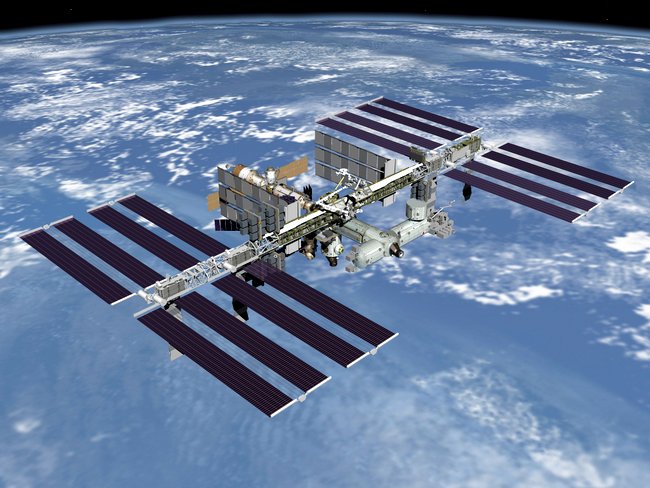
Space Station’s Slow-Scan Television System to be Active in April
The Amateur Radio Slow-Scan Television (SSTV) system on the International Space Station (ISS) is expected to be active in April on 145.800 MHz (FM). The Russian segment’s MAI 75 SSTV has announced transmissions on Monday, April 2, 1505 – 1830 UTC, and on Tuesday, April 3, 1415 – 1840 UTC.
“Reviewing the crew schedule, the SSTV activity, which uses Amateur Radio on the International Space Station (ARISS) radios, was coordinated around ARISS school contacts and is listed for April 2 and April 3,” said NASA ISS Ham Project Coordinator Kenneth Ransom, N5VHO.
The SSTV system, which uses the call sign RS0ISS, is also expected to be active from April 11 – 14 worldwide to mark Cosmonautics Day in Russia on April 12. Specific transmission times are not yet available. Images on all dates will be related to the Soviet Union’s Interkosmos cooperative space ventures project.
SSTV images will be transmitted in PD-120 format on 145.800 MHz (FM) using the Kenwood TM-D710 transceiver in the ISS Russian Service Module. ISS transmissions use the 5-kHz deviation FM standard. It’s possible to receive SSTV transmissions with only a handheld transceiver and appropriate SSTV software[…]
Click here to read the full article on the ARRL website.
from dx news https://ift.tt/2pRjrii
via IFTTT

Many thanks to SWLing Post contributor, David Iurescia (LW4DAF), who notes that NHK World Radio Japan has posted their A-18 Schedule (March 25 – October 28) for download.
Click here to download a PDF copy.
from dx news https://ift.tt/2If7XMj
via IFTTT
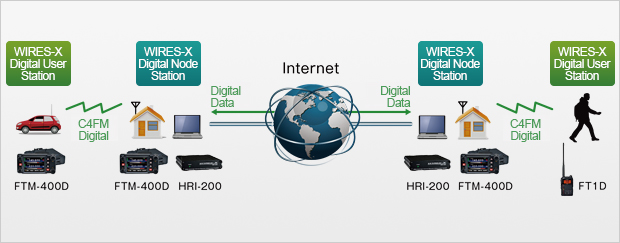
The WIRES-X Network (Source: Yaesu)
Many thanks to SWLing Post contributor, Dave Zantow (N9EWO), who asks:
How many of you Amateur Radio folks reading this web page have WIRES-X capability (either with a local node on your own or have access to it via a repeater) ?? I ask this as a possibility of a casual net of some kind ? We have WIRES-X (local node) here and would be willing to at least try a test run of a weekly or semi weekly “SWL – Receiver Net” IF we receive enough feedback (even if only a few readers). So I would appreciate an email back with a thumbs up or down to this idea and that you would be at least a check in ? Also please give me ideas when you would think a good day of the week and time would be (USA) ? If I receive zero feed back, of course I will not waste my time (but I think it would be fun to at least give it a try).
I only recently acquires a WIRES-X capable handheld: the Yaesu FT2DR. Now I need to find out if there is a WIRES-X capable repeater I can hit from my home. Of course, for me it’s always finding a reliable time to meet–that’s the real challenge! Great idea, Dave!
Post Readers: Contact Dave if you’re interested–his email can be found at the top of his homepage.
from dx news https://ift.tt/2pSxHXV
via IFTTT
Southgate ARC – Check-out the latest additions to G4RGA’s comprehensive rally and hamfest guide
from dx news https://ift.tt/2GXFbjK
via IFTTT
Southgate ARC – Hannes Coetzee, ZS6BZP, reports that the solar activity is expected to remain at very low levels
from dx news https://ift.tt/2E8Ei51
via IFTTT
Southgate ARC – We saw no sunspots during this reporting week, March 22-28. The previous week had sunspots on only three days, with an average of 5.6
from dx news https://ift.tt/2GYrkKb
via IFTTT
Southgate ARC – Video of the talk given by Professor Joe Taylor K1JT about the FT-8 and WSPR modes at the 2018 MicroHAMS Digital Conference on March 24
from dx news https://ift.tt/2pUp3aE
via IFTTT
Southgate ARC – Chris Rolinson G7DDN asks what is the greatest hobby on earth? Now there’s a question! For many of you reading this article, the answer will be clear – Amateur Radio. It’s a hobby that delights, excites and, at times, frustrates in probably equal measures!
from dx news https://ift.tt/2GZihbH
via IFTTT


