Search This Blog

DXER Ham Radio DX News

The latest dx news/current propagation and more. Visit mike's Amateur Radio Page at www.qsl.net/swlham

Showing posts with label May 30. Show all posts

Wednesday, May 30, 2018

Eagles Guitarist Joe Walsh, WB6ACU, Promotes Amateur Radio in Media Announcements

Legendary rock guitarist Joe Walsh, WB6ACU, of the Eagles is featured in a just-released set of ARRL audio and video public service announcements promoting Amateur Radio. ARRL will provide the 30- and 60-second PSAs to Public Information Officers (PIOs) to share with their Section’s television and radio stations. The ARRL Media and Public Relations Department also will provide these announcemen…

from rssfeedtop10 https://ift.tt/2xt1n4b
via IFTTT

POLL – HF noise levels

This latest poll was formulated by reader Zoran, WA7AA. If you have ideas for future polls, then please get in touch.

from rssfeedtop10 https://ift.tt/2L9TyTd
via IFTTT

Poland to Expand Local DAB+ Services

DXCC Approved. From DXNews.com

The DXCC Department has approved the following operations

from rssfeedtop10 https://ift.tt/2nsVCxD
via IFTTT

For the 13th Year Running, Riedel Provides Immense Signal and Comms Infrastructure for European Song Contest

Alaskan Arrow LEO Satellite Antenna – 4 Elements for 2 Meters crossed with 10 Elements for 70 cm

DXNL News No. 2095

  DXNL 2095 – May 30, 2018
                      DX Newsletter
                a free and weekly service of
                   DARC Committee “DX”
                 (http://www.darcdxhf.de)
                Editor: Klaus Poels, DL7UXG
                (e-mail: dxnl@dxhf.darc.de)
            translation by: Oliver Bock, DJ9AO
6O, Somalia:
     Baldur/DJ6SI had to change is callsign for his ongoing operation
     from Somalia into 6OX. He remains active until June 6 on 20 and
     30m. QSL via DJ6SI.
9X, Rwanda:
     Harald/DF2WO will be back on the bands as 9X2AW from Kigali between
     June 5 and 24 on CW, SSB, FT8, and RTTY. QSL via M0OXO, LoTW.
F, France:
     The special event station TM24H operates around the 24h of Le Mans
     between the 3rd and 17th of June on 80-10m (SSB, CW, RTTY, PSK,
     FT8). QSL via F6KFI (d/B).
F, France:
     Members of the radio club F4KJP will be commemorating Franck Tonna
     (F5SE), who passed away in December last year, with the callsign
     TM5SE on June 2&3. QSL via F4KJP (d/B).
GW, Wales:
     The Barry Amateur Radio Society of South Wales operates as GB4RME
     on June 1&2 from the Royal Mint. The Royal Mint hosts an event to
     celebrate the launch of a new “James Bond Special Agent” 10 pence
     coin together with an exhibition on covert radio as used in WW2.
     QSL via GW0ANA (d/B), LoTW.
I, Italy:
     The ARI section Fidenza (IQ4FE) honours the memory of Andre Marie
     Ampere during June with the callsign II4AMP. QSL via IQ4FE.
LZ, Bulgaria:
     The Bulgarian radio club Blagovestnik (LZ1KCP) continues to honour
     the memory of Bulgarian Saints during June with the call LZ430PPW.
     QSOs count for the All Saints – 2018 award. QSL via bureau, LZ1KCP
OH0, Aland Island:
     Juha/OH5CW and a group of ops from OH5C will be active as OG0C and
     OG0C/p from Kokar (EU-002, WW Loc. KO09) between June 2 and 6 on
     80-2m (CW, SSB, FT8). QSL via OH5CW, LoTW.
S9, Sao Tome and Principe:
     David/EB7DX plans to operate holiday-style from June 1 to 9 as S9ZZ
     from Sao Tome Island (AF-023). QRV on 40-6m on SSB, RTTY, FT8, and
     CW. QSL via EB7DX (d), ClubLog OQRS. http://eb7dx.com/oqrs/
YB, Indonesia:
     YB50AR and the following other special event calls will be
     celebrating the 50th anniversary of the Indonesian amateur radio
     organisation Organisasi Amatir Radio Indonesia (ORARI) during June:
     YB50AC, YB50BA, YB50BB, YB50BE, YB50BT, YB50GO, YB50JA, YB50JB,
     YB50JI, YB50JK, YB50JT, YB50KB, YB50KI, YB50KR, YB50KS, YB50KT,
     YB50LA, YB50MA, YB50MU, YB50NB, YB50NT, YB50PA, YB50RI, YB50SA,
     YB50SB, YB50SG, YB50SN, YB50SR, YB50SS, YB50ST, YB50SU, and YB50YO.
     An award will be available as well. QSL via LoTW.
ZL, New Zealand:
     ZM50LA is a special event call commemorating maritime tragedies 50
     years ago. During June the respective event is the sinking of
     freighter MV Maranui (callsign ZMLA). QSL via bureau.
Other stuff:
============
HAM Radio 2018 at Friedrichshafen:
     This Ham Radio event will take place from June 1 to 3 in
     Friedrichshafen.
Football World Championship 2018:
     FIFA’s world championship 2018 in male football takes place from
     June 14 until July 15 in Russia. Many special event stations are
     going to start an activity on the bands on June 1. From Russia,
     calls will be active denoting the participating teams, e.g. R18ARG,
     R18AUS, R18BE, as well as callsigns referring to the host cities,
     e.g. RC18EK, RC18KA, RC18MO etc. Participating nations and other
     countries will be joining in with many more special event calls,
     e.g. DJ18FWC, VR2FIFA, YW18FIFA, A60FIFA etc. An award will be
     available as well. For more information see:
Abbreviations in this DXNL:
===========================
ARLHS    Amateur Radio Lighthouse Society
IOCA     Islands of Croatia Award
IOTA     Islands on the Air
LoTW     Logbook of the World
OQRS     Online QSL Request System
WCA      World Castles Award
WLOTA    World Lighthouse On The Air Award
WRTC     World Radiosport Team Championship
Upcoming Contests:
==================
02.06.                 LZ Open Contest
02/03.06.              IARU Region 1 Fieldday
02/03.06.              Dutch Kingdom Contest
02/03.06.              Alabama QSO Party
IOTA     Compiled by Andreas, DK5ON (iota@dxhf.darc.de)
====
IOTA QRGs
CW:  28040 24920 21040 18098 14040 10114 7030 3530 kHz
SSB: 28560 28460 24950 21260 18128 14260 7055 3760 kHz
EU-016; 9A, Dalmatia South group: Marco/IV3WMS is currently active
     as 9A/IV3WMS from Solta Island (IOCA CI-126) until June 6 on HF
     (SSB only). QSL via IV3WMS (d/B).
EU-137; SM7, Skane County group: Lars/SM6CUK activates Ven Island
     between June 5 and 12, signing SA6G/7 on 40-6m (mostly on CW). QSL
     v ia SM6CUK (d/B), ClubLog, LoTW.
NA-085; W4, Florida State North West (Bay to Wakulla County) group:
     Bruce/K5TEN operates from Dog Island as K4D between the 2nd and 9th
     of June. QRV on 40-6m on SSB and CW. QSL via K5TEN.
OC-137; VK4, Queensland State (South Coast) South group: Mike/VK4DX
     plans to put Russel Island on the air from June 1 to 3 as VK4DX/p.
     QRV on 80-20m (SSB, CW). QSL via VK4DX (d), LoTW. http://vk4dx.com/
OC-164; VK6, Western Australia State (S.W. Coast) South group:
     Craig/VK5CE plans to activate several IOTA references during June.
     His first stop will be Rottnest Island on June 2 as VK5CE/6. QSL
     via VK5CE (d). https://vkiota.wordpress.com/
OC-199; VK6, Western Australia State (N.W. Coast) Centre group:
     Craig’s/VK5CE second stop will be East Lewis Island between June 4
     and 7, where he plans to operate as VK5CE/6 as well. QSL via VK5CE
SA-047; PY5, Parana State group: Eight operators are planning an
     activation of the Ilha do Mel for May 31 to June 3. QRV as PR5M
     with several rigs on 80-10m (CW, SSB, digital modes). QSL via
     PP5BZ, ClubLog.
WCA Activities
===============
WCA QRGs:
CW: 28031 24911 21031 18081 14031 10121 7031 3531 kHz
SSB: 28551 24951 21251 18131 14251 7131 3731 kHz
Juromenha Fortification – CT-00178:
     Members of the Clube Radioamadores do Entroncamento will be
     activating this reference between May 31 and June 2 on HF (SSB, CW,
     digital modes) as CS2JU.
Calendar
========
start      – end        DX              DXNL
01.05.     – 30.06.     4U29MAY         2092
19.04.     – 27.06.     4X70A           2089
19.04.     – 27.06.     4X70E           2089
19.04.     – 27.06.     4X70I           2089
19.04.     – 27.06.     4X70J           2089
19.04.     – 27.06.     4X70L           2089
19.04.     – 27.06.     4X70R           2089
19.04.     – 27.06.     4X70S           2089
19.04.     – 27.06.     4Z70IARC        2089
           – 05/18      5V1JE           2077
01.01.     – 31.12.     5W20SAMOA       2075
01.10.     – 30.09.19   5Z4/DL2RMC      2008
23.05.     – 01.06.     6E5RM           2094
           – 06.06.     6OX             2095*
           – 12/2018    6W1SU           2012
23.05.     – 02.06.     6Y6N            2094
01.01.     – 31.12.     7S75AA          2076
01.04.     – 31.03.19   8J1IRW          2087
30.04.     – 30.05.     8J1ITU          2090
01.04.     – 28.02.19   8J1KZ           2091
01.06.     – 31.05.     8J1ZIU          2055
01.04.     – 28.02.19   8J2OGAKI        2086
10.11.     – 27.06.     8J3B            2079
03.03.     – 30.11.     8J4B            2084
01.01.     – 31.05.     8J7HCB          2073
01.01.     – 31.12.     8N0400N         2076
28.05.     – 06.06.     9A/IV3WMS       2095*
27.04.     – 08.06.     9A/PA4JJ        2090
01.03.     – 31.12.     9A200S          2082
24.05.     – 31.05.     9H3SV           2094
21.05.     – 11.06.     9M6NA           2094
           – 10/2019    9Q6BB           2012
05.06.     – 24.06.     9X2AW           2095*
24.05.     – 03.06.     A25VR           2094
31.05.     – 02.06.     CS2JU           2095*
01.01.     – 31.12.     DA200FWR        2073/2076
01.04.     – 31.03.19   DB25ONN         2086
01.01.     – 31.12.     DB50EFAPB       2073
01.01.     – 31.12.     DF1000ZEIL      2073
01.03.     – 30.09.     DF18HET         2087
01.01.     – 31.12.     DJ70WAE         2073
01.01.     – 31.12.     DK200MARX       2073
01.01.     – 31.12.     DK60BIB         2074
01.01.     – 31.12.     DL100BY         2080
01.01.     – 31.12.     DL60BIB         2074
01.01.     – 31.12.     DL70PADER       2073
01.02.     – 31.12.     DM125FS         2083
01.04.     – 31.12.     DM152ZYA        2090
01.05.     – 31.05.     DM200MARX       2091
01.05.     – 30.06.     DM65MVP         2090
01.01.     – 31.12.     DM900ZWI        2074
01.01.     – 30.06.     DM90AIW         2073
01.01.     – 31.12.     DQ2018KTMS      2074
01.01.     – 31.12.     DQ800HRO        2074
10.05.     – 30.05.     EG8CID          2092
01.01.     – 31.12.     EI100MCV        2074
01.04.     – 31.12.     EM30N           2087
25.05.     – 15.06.     FR/F4HPX        2094
01.06.     – 02.06.     GB4RME          2095*
01.03.     – 31.05.     GB80GGCN        2082
01.01.     – 31.12.     HA50KVG         2077
01.07.     – 30.06.     HA60FMV         2048
           – 11.04.19   HF40CUF         2092
15.08.     – 08/18      HF700LUB        2054
01.01.     – 03.06.     HH70A           2074
           – 06/18      HK3JCL          2060
20.03.     – 20.10.     IB2RT           2087
01.02.     – 31.12.     II0GM           2078
01.04.     – 31.12.     II0LDV          2086
01.01.     – 31.12.     II2RR           2081
01.06.     – 30.06.     II4AMP          2095*
01.01.     – 31.12.     II4MXW          2076
01.05.     – 31.05.     II4TES          2090
           – 31.12.19   J28ND           2035
           – 01.09.19   J28PJ           2004
15.03.     – 15.06.     JG8NQJ/JD1      2084
04.12.     – 03.06.     JW2US           2069
           – 01.06.     JW4JSA          2071
02.06.     – 09.06.     K4D             2095*
02.05.     – 01.06.     KH6/N2HX        2091
01.02.     – 31.05.     KL7RST          2078
04.02.     – 31.05.     L50A            2081
01.01.     – 31.12.     LM90C           2076
01.01.     – 31.12.     LM90HQ          2076
01.01.     – 31.12.     LM90NRRL        2076
01.05.     – 31.05.     LZ110SAE        2090
01.01.     – 31.07.     LZ115RF         2075
01.06.     – 30.06.     LZ430PPW        2095*
01.05.     – 31.05.     MX1SWL/a        2090
11.03.     – 13.11.     OE100xxx        2084
02.06.     – 06.06.     OG0C            2095*
01.01.     – 31.12.     OG60F           2076
01.05.     – 31.12.     OM75TESLA       2092
01.05.     – .          31.05.          OT70xxx
01.01.     – 31.12.19   OU0POLIO        1919
19.05.     – 21.05.     OU7G            2093
01.02.     – 31.05.     OX7RST          2078
08.05.     – 10.06.     PA111SCOUTS     2091
31.05.     – 03.06.     PR5M            2095*
01.01.     – 31.12.     S510SOTA        2080
21.04.     – 31.05.     S79LD           2091
01.06.     – 09.06.     S9ZZ            2095*
05.06.     – 12.06.     SA6G/7          2095*
01.01.     – 31.12.     SN20UM          2073
           – 12/2018    SU9JT           2082
24.05.     – 05.06.     SW8WW           2094
03.06.     – 17.06.     TM24H           2095*
12.01.     – 16.06.     TM390SR         2075
01.05.     – 31.10.     TM53J           2090
02.06.     – 03.06.     TM5SE           2095*
18.09.     –            TR8CA           1902
           – 2018       TY2CD           1914
           – 10/2018    TY2SN           1957
01.02.     – 31.05.     VE8RST          2078
01.03.     – 31.05.     VI4GAMES        2082
01.06.     – 03.06.     VK4DX/p         2095*
02.06.     – 07.06.     VK5CE/6         2095*
01.07.     – 30.06.     VR20….        2047
01.02.     – 31.05.     VY0RST          2078
01.02.     – 31.05.     VY1RST          2078
01.06.     – 30.06.     YB50AR          2095*
01.02.     – 31.07.     YR630SV         2082
12/17      – 05/18      YS1/HB9KNA      2076
05/17      – 05/2020    ZL7DX           2040
05/17      – 05/2020    ZL7QT           2040
01.06.     – 30.06.     ZM50LA          2095*
*  = new or updated
.. = and other calls
QSL information
===============
4L2M              via    EA7FTR
4U29MAY           via    9A2AA
4X70A                                 (L), (e)
4X70E                                 (L), (e)
4X70I                                 (L), (e)
4X70J                                 (L), (e)
4X70L                                 (L), (e)
4X70R                                 (L), (e)
4X70S                                 (L), (e)
4Z70IARC                              (L), (e)
4Z80FOC           via    4Z4KX        (d), (L)
5P0HRH                                (C), (O), (L), (e)
5P8ICE                                (C), (L), (e)
5P90EDR           via    OZ1ACB,      (L), (C), (e)
5V1JE             via    N9MDH        (d), (L)
5W20SAMOA         via    EA5GL,       (C), (L), (e)
5Z4/DL2RMC        via    DL1RTL       (d/B)
6E5RM             via    XE3N
6E5RM/XF3         via    XE3N
6OX               via    DJ6SI
6W1SU             via    M0URX
6Y6N              via    DK9PY        (d/B)
7S6WX                                 (B), (L)
7S75AA            via    SK5AA        (B),
SM5FUG                                (d)
8J1IRW            via    (B),         JH1DSF (d)
8J1ITU                                (B), (e)
8J1KZ                                 (B)
8J1ZIU                                (B)
8J2OGAKI          via    (B),         JJ2ONH (d)
8J3B              via    (B),         JK3IJQ (d)
8J4B                                  (B)
8J7HCB            via    (B),         JK7LXU (d)
8N0400N                               (B)
8P1W              via    KU9C
9A/IV3WMS         via    IV3WMS       (d/B)
9A/PA4JJ          via    PA4JJ,       (C), (L)
9A200S            via    9A2MF
9H3EE             via    OZ1BII,      (C), (L)
9H3SV             via    SV2CLJ       (d)
9J80FOC           via    G3TEV        (d)
9K2K              via    EC5AC,       (L)
9M6NA             via    JE1JKL,      (L), (C)
9Q6BB             via    W3HNK
9X2AW             via    M0OXO,       (L)
A25VR             via    VE7VR
CR3DX             via    OM2VL        (d/B)
CT9ABN            via    OM2VL        (d/B)
DA200FWR          via    (B),         DK2PU (d)
DB25ONN                               (d/B)
DB50EFAPB                             (B)
DF1000ZEIL                            (B)
DF18HET           via    (B),         DG3FFM (d), (e)
DF80FOC                               (L), (C)
DJ70WAE                               (B)
DJ80FOC           via    DJ5IL        (B)
DK200MARX         via    (B),         DK5PZ (d), (C)
DL100BY                               (B)
DL70PADER                             (B)
DM125FS                               (B)
DM152ZYA                              (B)
DM200MARX                             (B)
DM65MVP                               (B), (e)
DM900ZWI          via    DM5JBN       (d/B)
DM90AIW                               (B), (C), (e)
DP1POL            via    DL1ZBO
DQ2018KTMS                            (B), (e)
DQ800HRO          via    DL5KVV       (d/B)
E51BAS            via    AD7MM        (d), (L)
E51DLD            via    W6HB         (d)
EF8R              via    EB7DX        (d), (L)
EG8CID            via    EA8URL,      (L)
EI100MCV                              (B)
EM30N             via    UR4NWW
EM80FOC           via    UR5MM
FR/F4H            PX    via          F4HPX (d/B), (L), (C)
GB4RME            via    GW0ANA       (d/B), (L)
GB5FOC                                (e), (L), (C)
GB60OT            via    G3KPU        (d), (B), (e)
GB80GGCN          via    (B),         G0TOC (d)
GP4FOC            via    G3SWH
GR9RW             via    G4DFI,       (O)
GX4BJC/a          via    G6XOU        (d/B), (e)
GX4FOC            via    G3SWH
HA50KVG           via    HA8KVG
HA60FMV                               (B)
HB9GOLD           via    HB9OCR       (d/B), (L), (e)
HF40CUF           via    SP4CUF
HF700LUB          via    SP8AB
HH70A             via    W3HNK
HK3JCL            via    DK8LRF       (d/B)
HQ9X              via    KQ1F
IB0/IK4ALM        via    IK4ALM
IB0/IK4JPN        via    IK4JPN
IB0/IK4RQJ        via    IK4RQJ
IB0/IK4RUX        via    IK4RUX
IB0/IZ4WJA        via    IZ4WJA
IB2RT             via    (B),         I2MYF (d), (e)
II0GM             via    I0KQB        (d), (e)
II0LDV            via    I0KQB        (d)
II2RR             via    IK2VUC
II4AMP            via    IQ4FE
II4TES            via    IQ4FE
J28ND             via    S57DX
J28PJ             via    F1TMY
JG8NQJ/JD1        via    JA8CJY
JW2US                                 (C), (L)
JW4JSA            via    LA4JSA
JW8DW             via    LA8DW        (d/B), (L)
K4D               via    K5TEN
KH6/N2HX          via    N2HX         (d/B)
KL7RST            via    K7ICE        (d)
KL7RRC/p          via    N7RO         (d/B), (C)
L50A              via    LU4AAO       (d/B), (e)
LM90C                                 (B)
LM90HQ                                (B)
LM90NRRL                              (B)
LZ110SAE          via    (B),         LZ1KCP (d)
LZ115RF           via    LZ1YE
LZ430PPW          via    (B),         LZ1KCP (d)
MX1SWL/a          via    G6XOU        (d/B), (e)
OE100AIR          via    OE8AIR       (B)
OE100AKD                              (B)
OE100BKC          via    OE3BKC       (B)
OE100CQB                              (d), (e)
OE100CQM                              (d/B)
OE100DMA          via    OE3DMA       (d/B)
OE100EGN          via    OE5EGN       (B), (L), (e)
OE100FTE          via    OE6FTE       (B), (L), (e)
OE100GBK          via    OE8GBK       (B)
OE100GTU                              (e)
OE100IIO          via    OE5IIO       (B), (e)
OE100JML                              (d/B), (e)
OE100JWD          via    OE6JWD
OE100KLG                              (B), (L), (e)
OE100MPI          via    OE7MPI
OE100NIP                              (B)
OE100PGM                              (B)
OE100PKB          via    OE3PKB       (B)
OE100RNS          via    OE3RNS       (B)
OE100SGU          via    OE3SGU       (L), (e)
OE100TWB                              (B)
OE100VIE          via    OE4VIE       (d), (L), (e)
OE100WLE                              (d/B)
OE100WMA          via    OE3WMA
OE100XFG                              (B)
OE100XGM          via    OE5XGM       (d)
OE100XWI                              (B), (e)
OE100YSC          via    OE3YSC       (B)
OE100YXK          via    OE8YXK       (B)
OE100ZKC          via    OE1ZKC
OG0C              via    OH5CW,       (L)
OG60F             via    OH1NOA,      (L), (C)
OH0/OH4SS         via    OH4SS        (d)
OM75TESLA         via    OM3KHT       (d/B)
OT70xxx                               (C), (O)
OU0POLIO          via    OZ1ACB       (d/B)
OU7G                                  (d/B)
OX50HRH                               (C), (O), (L), (e)
OX5HRH                                (C), (O), (L), (e)
OX7RST            via    K7ICE        (d)
OZ18ICE                               (C), (L), (e)
OZ50HRH                               (C), (O), (L), (e)
P44W              via    N2MM         (d), (L)
PA/DL1EAL         via    DL1EAL       (d/B), (L). (e)
PA111SCOUTS       via    PA3EFR
PJ8RV             via    JA1HGY,      (L)
PJ8Z              via    JH1AJT,      (C), (L)
PR5M              via    PP5BZ,       (C)
R0LS/p          (d/B)
S580FOC                               (L), (O)
S79LD             via    VK4EF        (d)
S9ZZ              via    EB7DX        (d), (C)
SA6G/7            via    SM6CUK       (d/B), (L), (C)
SC80FOC           via    SM2EKM       (d), (L)
SN20UM            via    SQ9UM
SU9JT             via    E73Y         (d/B), (C)
SW8WW             via    HA0HW        (B), (C)
SX80FOC                               (L), (C), (e)
TM24H             via    F6KFI        (d/B)
TM390SR           via    F4DTO        (d/B)
TM53J             via    F6KSU        (B), (e)
TM5SE             via    F4KJP        (d/B)
TR8CA             via    F6CBC
TY2CD             via    N4GNR        (d), (L)
VE8RST            via    K7ICE        (d)
VK4DX/p           via    VK4DX        (d), (L)
VK5CE/6           via    VK5CE        (d)
VQ9RA             via    WW6RG
VU8FOC            via    VU2PTT       (B)
VY0RST            via    K7ICE        (d)
VY1RST            via    K7ICE        (d)
YB50AR                                (L)
YB9/JJ1DQR        via    JJ1DQR
YR630SV                               (B), (e)
YR80FOC           via    YO3FLR       (d/B)
ZL7DX             via    M0OXO
ZL7QT                                 (d)
ZL80FOC           via    ZL2AGY       (B), (L)
ZM50LA                                (B)
ZS9FOC            via    ZS1C
(d) = direct   (B) = bureau ok  (L) = LoTW           (O) = OQRS
(C) = ClubLog  (e) = eQSL       (*) = new manager    (Q) = QRZ.COM
QSL rcvd via LoTW: E20HHK/p, P3X, TA7P, TF2MSN, UN3M, VR2XLN
Thanks for contributing to this issue of the DXNL:
  QRZ DX, I1JQJ/IK1ADH & 425 DX News, DxCoffee, DX World, VA3RJ,
  KB8NW & OPDX-Bulletin, DF6EX (fuer WIN-QSL), CS5CRE, DJ5AV, DJ9ZB,
  DK8JB, DK8MZ, DL1BAH, DL1SBF, DL7MAE, F6AJA & Les Nouvelles DX,
  GW0ANA, NG3K & ADXO, OE2IKN, OZ6OM & 50 MHz DX News, RSGB IOTA
  Homepage, W3UR & The Daily DX u.a.
Free subscription DXMB / DXNL:
==============================
Homepage and archives:
Change/Cancel subscription for mtw@charter.net:
Subscription overview: https://www.darcdxhf.de/dxmb/

This mail was sent to: mtw

How to build SM0VPO’s 20 meter magnetic loop antenna

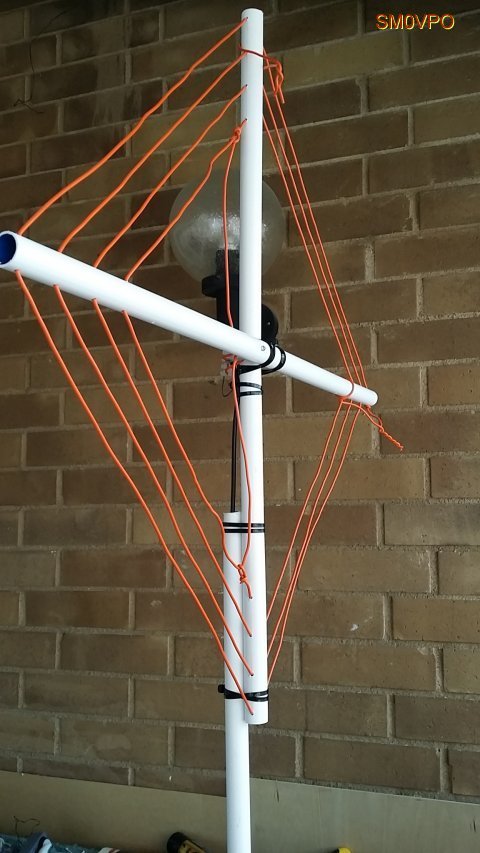
The completed 20 meter loop antenna.

A few days ago, SWLing Post contributor, Robert Gulley (AK3Q), pointed me to an excellent website by Harry Lythall (SM0VPO) which is chock-full of various homebrew radio projects. In particular, we both were impressed with Harry’s 20 Meter Loop Antenna–it’s such a simple project and requires no special order components. In fact, all of the components (save, perhaps, the antenna connector) can be purchased at a DIY store.

I reached out to Harry and he has kindly allowed me to republish this project as a guest post:


20m Loop Antenna

by Harry Lythall – SM0VPO

Introduction

I recently saw that my 80m (3.5MHz) loop (or frame) antenna has been really popular, and that there are loads of other radio amateurs who have taken my design and “ran with it” to produce variations that all have some great improvement. There have been many in-depth tests and simulations, all with exceedingly good results and reports. This is exactly what I am aiming for with my homepages – free information for all and my designs being improved upon. That way we all win 🙂

One small point all variations have in common is the need for an expensive tuning capacitor and a very restricted RF power level. Of course, you can throw money at the problem, but for me this hurts. I got to thinking that there must be a way of adjusting the design a little and finding another technique to tune the antenna, and to make the best use of the little radio transceiver I have in Sweden, given the limited space.

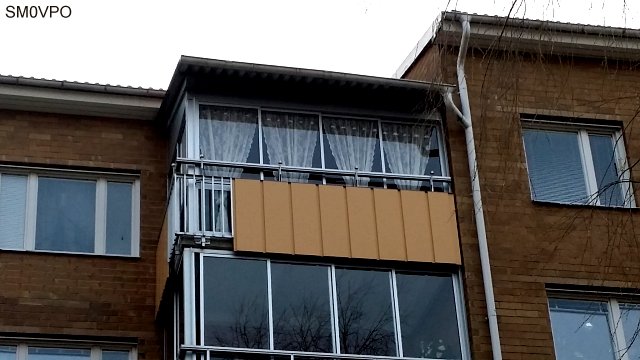
My limited space apartment.

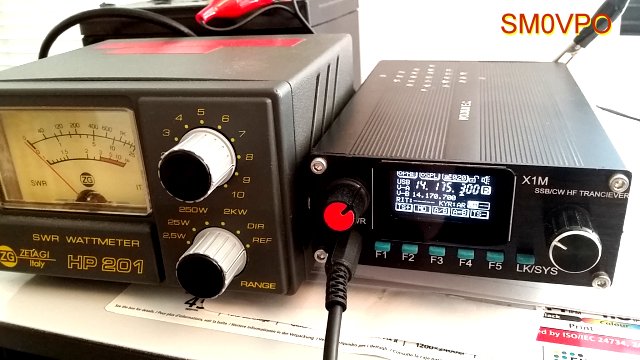
As you can see there is not much opportunity for grand antennas. And to add to this, the equipment I have in Sweden is also limited to a single 5-Watt unit.

My limited equipment – only 5-Watts.

The Design Thoughts

Today I have no area of land to use for antennas. I have a glassed-in balcony on the 4th floor of an apartment block. I really like the 20m (14MHz) band so I will concentrate on that. I am not really interested in the CW end of the band, except perhaps 14.070MHz for the digimodes. So my requirements are:

  • As efficient as possible (useable)
  • Small size, also portable so I can use it for field use
  • No expensive components, everything available locally
  • No TVI, QRM or interference to stereos or computer sound
  • Total price less than $2

The antenna I have created is based on my original 3.5MHz loop (or frame) antenna. This time I built it out of scrap components. I cadged (tiggade) some plastic conduit tubes from an electrical contractor at work. The same guy also gave me the remnants of a roll of 2.5mm C.S.A. multi-strand mains cable. That was all I needed.In my junkbox I found no tuning capacitors, but WAIT!! Why do I need to tune the antenna? Once it is tuned I should not need to tune it again, just set the centre-frequency to 14.175MHz. If I can get the Q-factor to around 100 then my useable 3dB bandwidth should be more than 150kHz. That will give me 14.10MHz to 14.25MHz.

Ok, I need a 1-off, preset tuning capacitor. Why not use a Gimmik Capacitor? Just twist two bits of wire together and cut it short to get the resonant frequency I want. So I need to get the coil wound so that there is sufficient cable length and self capacitance to give a resonance of about 14.5MHz without any extra capacitance what-so-ever. That means I need just a few pf. That sounds like a good plan.

Construction

The 15mm Diameter plastic tube I “aquired” were 80cm long. After much trial and error I found that exactly 3 turns, with 2.5cm spacing, gives about 14.9MHz self resonance. The wire support holes are exactly 4cm spaced, beginning 1cm from the end of each tube. The two tubes are fixed into a and X using zip-straps (tie-wraps, buntband). The feed loop is 1/2 turn.

Note the size and position of the feed loop. Also the Gimmik capacitor.

One problem I had with the original loop antenna was that of RF coming back down the cable braid. Using on old FT-101ZD it was possible to feel the RF on the microphone with your lips. The cure for this is to use a balanced feed and at least 5m of RF cable.

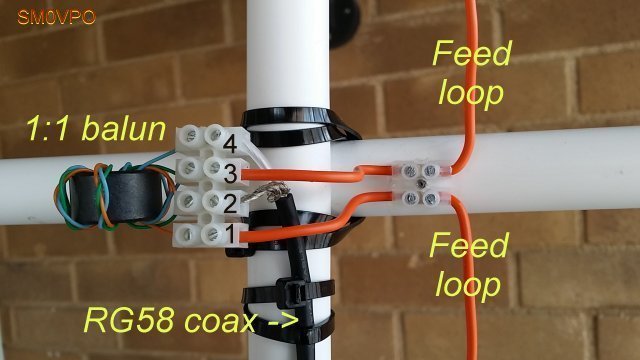
I robbed the ferrite ring for the balun from an old ATX computer PSU and made a triflar wound torroidal transformer. That is to say, twist together three lengths of 1mm x 7-strand insulated hookup wire together. Use this to make a 7-turn coil and connect the three coils in series, with four connections. Feed connections (numbered in the picture below) 1 and 3 are connected to to the antenna feed loop. Connect the coaxial cable braid to connection 2, and the coax centre to connection 4. My balun is self-supported on the connection leads.

The 1:1 Balun I used.

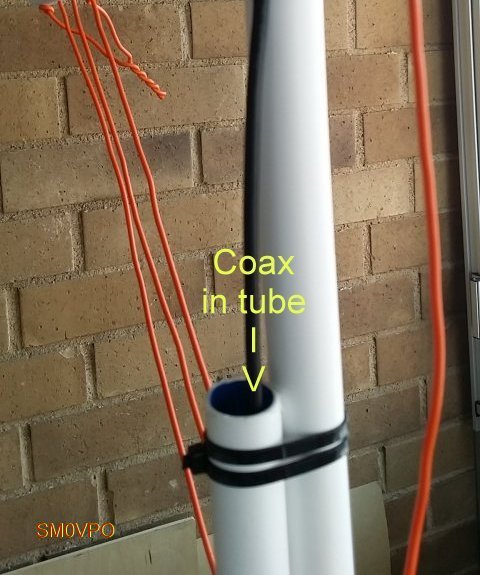
The coaxial feed cable was found to affect the resonance slightly, so I fed that through an extra bit of tube to make it stay in one place. It works fine.

Feeder cable secured in the support tube.

Testing

Testing is very easy. I used my GDO-2 to check the middle-turn of the loop for a dip. Twist the two tails together to form the Gimmik capacitor and adjust the length of the twist until the centre-frequency is 14.175MHz. With the GDO you can get it within about 100kHz to 200kHz, but then you can check the VSWR using your HF radio. You can also sweep the band for maximum noise and get a very close approximation.

The Gimmick capacitor.

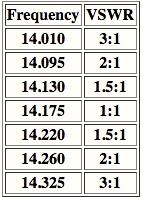
The centre frequency of my 20m Loop antenna is 14.175MHz, and the VSWR is better than 1.05:1 (I can hardly see any movement on my meter). The Q-factor is somewhere approaching 100. The useable bandwidth is just a little narrower than I would have wished, but the antenna certainly works well and meets all the other criteria. But the slightly less useable bandwidth criterion is at the expense of better performance, and it still allows me to use 14.070MHz, although it is a little quieter down there.

The completed antenna.

Conclusion

No-matter how you play with the figures, the best indoor antenna cannot replace a full-size dipole antenna. But the indoor antenna can give some extra features, such as just reaching out your arm and trimming a little, which you cannot do with a long-wire antenna up a tree out in the garden, especially when it is raining.

This antenna gets me on the air on 14MHz, and it has a useable frequency range. The VSWR is almost perfect at the centre-frequency, and this time I don’t burn my lips on the microphone (not that I am likely to do so with just 5-Watts of power). The design uses no expensive components, in fact the only item I bought was the block-connector for the balun. That cost me US$1.50 for a pair of 12-contact screw-terminals. The construction is ridiculously simple and easy to build.

On the air I can hear traffic on 14.070 digimodes, and from 14.130 to 14.220MHz I have a near-perfect VSWR aqnd good clear reception of SSB. I can also rotate the antenna to cut out rubbish, and most of all, using the Gimmik capacitor I don’t need to re-tune it: it seems temperatore-stable. The weight is less than 500g and when I poke it out of the balcony window the reception improves, the VSWR does not change, and I can make myself heard among the big boys.

I hope that you have some fun building and using this antenna. If you have any ideas for further improving it then please use my forum.

Don’t forget to visit my messageboard if you have any questions about this or any other project. I always look forward to receiving feedback, positive or negative.

Very best regards from Harry Lythall
SM0VPO (QRA = JO89WO), Märsta, Sweden.
EA/SM0VPO (QRA = IM86BS), Nerja, Spain.


Many thanks, Harry, for sharing this excellent project on the SWLing Post!

Post Readers: be sure to check out Harry’s website which is loaded with radio projects of all stripes. You’ll easily spend a few hours digging through his tutorials and downloads. Harry also maintains an alternate mirror server located here.

Side note: I’m impressed with the fact that the main SM0VPO website is actually hosted on a bedside Raspberry Pi computer (running the Linux-based Lighttp server).  Very cool!

Check out other homebrew mag loop antenna projects on the SWLing Post by clicking here.

from rssfeedtop10 https://ift.tt/2JcVFIB
via IFTTT

Radio TechCon 2018 Set for November

The VE3HLS Grand Finale Rove!

Southgate ARC – Ken, VE3HLS, reports, ‘Get out your highlighter and circle June 15th, 16th and 17th on your calendars! You don’t want to miss ‘The VE3HLS Grand Finale Rove!’

from rssfeedtop10 https://ift.tt/2J3C1Lx
via IFTTT

9X, Rwanda DXpedition

Southgate ARC – Members of the Italian DX Team will be active as 9X0T between September 27th and October 10th

from rssfeedtop10 https://ift.tt/2LIen9s
via IFTTT

NASA tv to air return of one space station crew, launch of another

Southgate ARC – Three of the current International Space Station crew members are scheduled to end their mission on Sunday, June 3. A few days later, another trio of space travelers will depart for the station on a launch scheduled for Wednesday, June 6

from rssfeedtop10 https://ift.tt/2J3BWHJ
via IFTTT

Solder-up PL259 connectors for RG174

Southgate ARC – RG174 is a thin co-axial cable that is popular for lightweight portable HF antennas. However finding solderable connectors for this cable is often quite a challenge

from rssfeedtop10 https://ift.tt/2LL0XJs
via IFTTT

Noctilucent cloud season begins

Southgate ARC – NASA’s AIM spacecraft has just spotted electric-blue clouds floating at the edge of space over the Arctic Circle

from rssfeedtop10 https://ift.tt/2xx0jwu
via IFTTT

Invitation to the 2018 NASA AAQ Workshop

Southgate ARC – The event targets academics (faculty, researchers, students) involved with space related activities such as cube sat, small sat, high altitude balloon, rocket and more. It is also designed for those wishing to be involved with NASA space related projects. The event will feature speakers and a poster session

from rssfeedtop10 https://ift.tt/2LJFlgM
via IFTTT

Ham radio promotional video now in Norwegian

Southgate ARC – The RSGB’s promotional video ‘Amateur Radio: A Hobby for the 21st Century’ has been translated into Norwegian

from rssfeedtop10 https://ift.tt/2xmsSfM
via IFTTT

China Microsatellite Symposium 2018

Southgate ARC – The China Microsatellite Symposium (CMS2018), will be held at Northwestern Polytechnical University, Xi’an China on 18th – 20th November 2018

from rssfeedtop10 https://ift.tt/2LJzqIn
via IFTTT

ARES activated in eight Maryland counties for severe flooding

Southgate ARC – Amateur Radio Emergency Service (ARES®) volunteers in the Maryland-DC Section activated in the wake of regional flash flooding on May 27

from rssfeedtop10 https://ift.tt/2xrPf3p
via IFTTT

17-year-old radio ham makes own integrated circuits

Southgate ARC – The IEEE reports 17-year-old radio amateur Sam Zeelof KD2ENL has turned his parent’s garage into a 1970s-era chip fab

from rssfeedtop10 https://ift.tt/2LFPHOG
via IFTTT