Search This Blog

DXER Ham Radio DX News

The latest dx news/current propagation and more. Visit mike's Amateur Radio Page at www.qsl.net/swlham

Showing posts with label 2018 at 06:00PM. Show all posts

Monday, April 23, 2018

Today’s Sun (artificially-colored in red) seen at the…

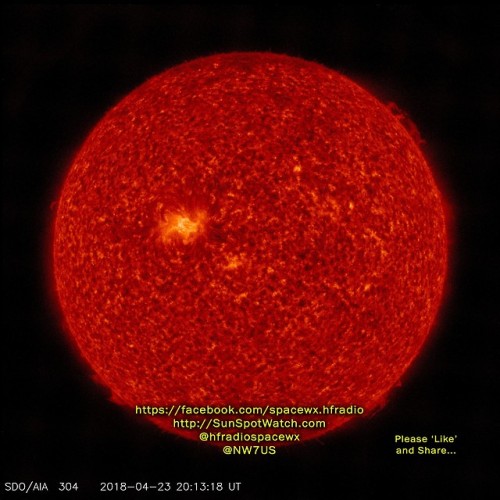
Today’s Sun (artificially-colored in red) seen at the 304-angstrom wavelength (Extreme Ultraviolet, or EUV), as viewed by the Solar Dynamics Observatory (SDO), by the Atmospheric Imaging Assembly (AIA).

At this wavelength, at a wavelength not seen by the un-aided eye, we can see the Sun through the 30.4 nm (304 A) filter. This Extreme Ultraviolet (EUV) waveband is used to monitor the chromosphere and lower transition region. It is useful to see plasma and filament activity, including filamet eruptions and coronal mass ejections (CMEs).

The image is a “false color image’, meaning that observed data are in a range outside of what human eyes can see, so the data are digitally recast into colors that emphasize physically important features. This view is created from data gathered by the Solar Dynamics Observatory (SDO) satellite that flies above Earth’s atmosphere in an inclined geosynchronous orbit.

Emissions captured in this image come from helium (He), the second most abundant element in the solar atmosphere. Singly ionized Helium (He II) emits Extreme Ultraviolet (EUV) light when heated to temperatures of ~70,000 deg K. In the upper solar atmosphere the temperatures are so high that most chemical elements have lost many of their electrons. The remaining electron, which is still attached to the atom, emits EUV radiation in narrow wavebands or lines when it is in an excited state.

The 30.4 nm filter (also called channel or bandpass) is dominated by emissions from singly (once) ionized helium which has missing 1 electron–He II. The roman numeral descriptor is consistent with spectral notation: the level of ionization for a given roman numeral is one unit larger that the actual number of missing electrons. The temperatures associated with this level of ionization is range from 6 x 10^4 K to 8 x 10^4 K.

The bright regions in this image correspond to regions of closed magnetic field loops that trap the hot, emitting plasma. Large bright regions are often called active regions. The dark regions correspond to cooler temperatures and possibly to locations where magnetic field lines open into the heliosphere, and thus, do not trap hot plasma.

View live data and images at http://SunSpotWatch.com

= = = =

BOOK SALE: Space Weather and Sun Science – get these from Amazon, and help us stay online!

NOTICE: When you buy this (or any item after starting with this link), you are helping us keep our SunSpotWatch.com and other resources “on the air” (up and running!). In other words, you are helping the entire community. So, check out this book:

Here is the link to Amazon:
http://g.nw7us.us/fbssw-aSWSC

= = = =

Visit our live space weather and radio propagation web site, at: http://SunSpotWatch.com

See the live aurora mapping is at http://aurora.sunspotwatch.com

If you are on Twitter, please follow these two users:

1) https://Twitter.com/NW7US
2) https://Twitter.com/hfradiospacewx

We’re on Facebook: http://NW7US.us/swhfr

from toptenrss https://ift.tt/2qTsyPe
via IFTTT

Here is the current forecast discussion on space weather and…

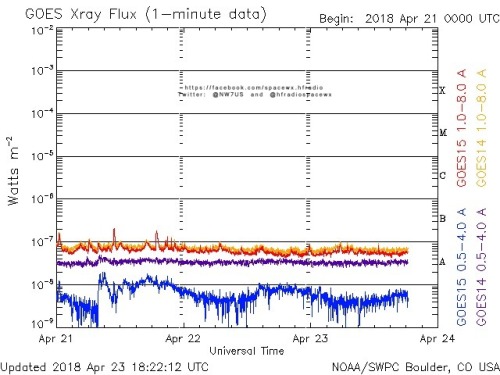
Here is the current forecast discussion on space weather and geophysical activity, issued 2018 Apr 23 1230 UTC.

Solar Activity

24 hr Summary: Solar activity was very low. Slight decay was observed in the trailing spots of Region 2706 (N03E22, Cao/beta). No Earth-directed CMEs were observed in available coronagraph imagery.

Forecast: Solar activity is expected to be very low, with a slight chance for C-class flare activity, over the next three days (23-25 Apr).

Energetic Particle

24 hr Summary: The greater than 2 MeV electron flux reached high levels this period with a peak flux of 22,704 pfu at 22/2050 UTC. The greater than 10 MeV proton flux was steady at background levels throughout the period.

Forecast: The greater than 2 MeV electron flux is expected to reach high levels each of the next three days (23-25 Apr) and the greater than 10 MeV proton flux is expected to persist at background levels throughout the forecast period.

Solar Wind

24 hr Summary: Solar wind speed continued to decline over the period from approximately 500 km/s to near 415 km/s. Total field ranged from 3-6 nT while the Bz component was between +/-4 nT. Phi angle was oriented in a negative (towards) sector.

Forecast: Solar wind parameters are expected to continue a slow return to background levels over the course of day one (23 Apr). Background solar wind conditions are expected to prevail on days two and three (24-25 Apr).

Geospace

24 hr Summary: The geomagnetic field was quiet to unsettled.

Forecast: The geomagnetic field is expected to be generally quiet over the next three days (23-25 Apr) under a nominal solar wind regime.

Don’t forget to visit our live space weather and radio propagation web site, at: http://SunSpotWatch.com/

Live Aurora mapping is at http://aurora.sunspotwatch.com/

If you are on Twitter, please follow these two users:
+ https://Twitter.com/NW7US
+ https://Twitter.com/hfradiospacewx

Check out the stunning view of our Sun in action, as seen during the last five years with the Solar Dynamics Observatory (SDO): https://www.youtube.com/watch?v=zXN-MdoGM9g

-=-=-=-=-=-

What’s the difference between CB & amateur (ham) radio? Here ia a video with an opinion by our curator, Tomas (amateur radio operator, NW7US): Did NCIS TV Show Malign the Amateur Radio Service? https://www.youtube.com/watch?v=pIWJ7kKbxiM?t=1m33s

We’re on Facebook: http://NW7US.us/swhfr

from toptenrss https://ift.tt/2HlbIUx
via IFTTT

Puerto Rico: AM Radio makes a comeback post-hurricane

(Source: Columbia Journalism Review)

ON SEPTEMBER 19, 2017—the day before Hurricane Maria made landfall in Puerto Rico—the evening news team at WORA-TV in the coastal city of Mayagüez broadcast its final program before shutting down the station ahead of the storm.

“If Maria was going to be the monster everyone was predicting,” says Carolina Rodriguez Plaza, the news team’s production manager, “we knew the power could be cut off for a long time. We decided to shut down the station and send everyone home.”

Plaza told her team of 12 reporters not to worry, their salaries would be paid during the downtime and their jobs would be waiting for them when broadcasting resumed. Plaza retreated to her parents’ home, where she spent the night of the hurricane watching updates about the storm on cable TV. Then, as happened in homes across Puerto Rico, the lights flickered and the power went out. Hurricane Maria’s 150-mile-per-hour winds toppled power lines and torrential rains grounded out the island’s power grid.

Desperate for news about the disaster befalling her island, Plaza turned on a battery-powered radio and found that a local radio station, WKJB 710 AM, was maintaining its broadcast. The station’s managers had learned a lesson about disaster preparedness in 1998, when Hurricane Georges blew down their radio antenna and cut off the power. Since then, staff had equipped the station with a backup power generator and a reinforced antenna that could withstand hurricane-force winds.

“Maria erased the world of journalism in Puerto Rico,” Plaza says. “It reemerged in a new form, with radio playing an important role.”[…]

Click here to read the full article at the CJR.

from toptenrss https://ift.tt/2qTseju
via IFTTT

YC8AO/P Taka Bonerate Islands. From DXNews.com

Andi, YC8AO will be active as YC8AO/P from Taka Bonerate Islands, IOTA OC – 242, 25 – 30 April 2018.

from toptenrss https://ift.tt/2Hp9dk4
via IFTTT