Search This Blog

DXER Ham Radio DX News

The latest dx news/current propagation and more. Visit mike's Amateur Radio Page at www.qsl.net/swlham

Showing posts with label April 22. Show all posts

Sunday, April 22, 2018

Today’s Sun (artificially-colored in red) seen at the…

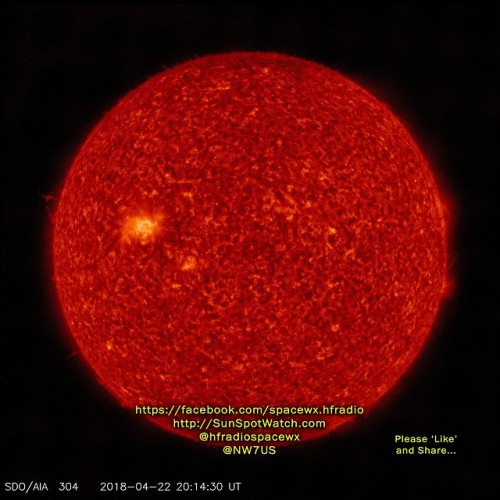
Today’s Sun (artificially-colored in red) seen at the 304-angstrom wavelength (Extreme Ultraviolet, or EUV), as viewed by the Solar Dynamics Observatory (SDO), by the Atmospheric Imaging Assembly (AIA).

At this wavelength, at a wavelength not seen by the un-aided eye, we can see the Sun through the 30.4 nm (304 A) filter. This Extreme Ultraviolet (EUV) waveband is used to monitor the chromosphere and lower transition region. It is useful to see plasma and filament activity, including filamet eruptions and coronal mass ejections (CMEs).

The image is a “false color image’, meaning that observed data are in a range outside of what human eyes can see, so the data are digitally recast into colors that emphasize physically important features. This view is created from data gathered by the Solar Dynamics Observatory (SDO) satellite that flies above Earth’s atmosphere in an inclined geosynchronous orbit.

Emissions captured in this image come from helium (He), the second most abundant element in the solar atmosphere. Singly ionized Helium (He II) emits Extreme Ultraviolet (EUV) light when heated to temperatures of ~70,000 deg K. In the upper solar atmosphere the temperatures are so high that most chemical elements have lost many of their electrons. The remaining electron, which is still attached to the atom, emits EUV radiation in narrow wavebands or lines when it is in an excited state.

The 30.4 nm filter (also called channel or bandpass) is dominated by emissions from singly (once) ionized helium which has missing 1 electron–He II. The roman numeral descriptor is consistent with spectral notation: the level of ionization for a given roman numeral is one unit larger that the actual number of missing electrons. The temperatures associated with this level of ionization is range from 6 x 10^4 K to 8 x 10^4 K.

The bright regions in this image correspond to regions of closed magnetic field loops that trap the hot, emitting plasma. Large bright regions are often called active regions. The dark regions correspond to cooler temperatures and possibly to locations where magnetic field lines open into the heliosphere, and thus, do not trap hot plasma.

View live data and images at http://SunSpotWatch.com

= = = =

BOOK SALE: Space Weather and Sun Science – get these from Amazon, and help us stay online!

NOTICE: When you buy this (or any item after starting with this link), you are helping us keep our SunSpotWatch.com and other resources “on the air” (up and running!). In other words, you are helping the entire community. So, check out this book:

Here is the link to Amazon:
http://g.nw7us.us/fbssw-aSWSC

= = = =

Visit our live space weather and radio propagation web site, at: http://SunSpotWatch.com

See the live aurora mapping is at http://aurora.sunspotwatch.com

If you are on Twitter, please follow these two users:

1) https://Twitter.com/NW7US
2) https://Twitter.com/hfradiospacewx

We’re on Facebook: http://NW7US.us/swhfr

from toptenrss https://ift.tt/2qSOFW9
via IFTTT

Here is the current forecast discussion on space weather and…

Here is the current forecast discussion on space weather and geophysical activity, issued 2018 Apr 22 1230 UTC.

Solar Activity

24 hr Summary: Solar activity was very low. Slight growth was observed in the intermediate spots of Region 2706 (N03E36, Dao/beta). No Earth-directed CMEs were observed in available satellite imagery.

Forecast: Solar activity is expected to continue at very low levels, with a chance for C-class flare activity, throughout the forecast period (22-24 Apr).

Energetic Particle

24 hr Summary: The greater than 2 MeV electron flux reached high levels with a peak flux of 24,056 pfu at 21/2120 UTC. The greater than 10 MeV proton flux was steady at background levels.

Forecast: The greater than 2 MeV electron flux is expected to reach high levels each of the next three days (22-24 Apr) and the greater than 10 MeV proton flux is expected to continue at background levels throughout the forecast period.

Solar Wind

24 hr Summary: Solar wind speed continued to decline under waning influences of a negative polarity CH HSS. Solar wind speed decreased from approximately 600 km/s to near 490 km/s. Total field ranged from 4-6 nT while the Bz component was between +/-4 nT. Phi angle was oriented in a negative (towards) sector.

Forecast: Solar wind parameters are expected to continue a slow return to near-background levels over the course of day one (22 Apr) as CH HSS influence subsides. A background solar wind environment is expected on days two and three (23-24 Apr) with the return of a nominal solar wind regime.

Geospace

24 hr Summary: The geomagnetic field was quiet to unsettled this period under weakening CH HSS influence.

Forecast: The geomagnetic field is expected to be quiet and unsettled on day one (22 Apr) as CH HSS influence wanes. Generally quiet conditions are expected on days two and three (23-24 Apr) as a nominal solar wind regime prevails.

Don’t forget to visit our live space weather and radio propagation web site, at: http://SunSpotWatch.com/

Live Aurora mapping is at http://aurora.sunspotwatch.com/

If you are on Twitter, please follow these two users:
+ https://Twitter.com/NW7US
+ https://Twitter.com/hfradiospacewx

Check out the stunning view of our Sun in action, as seen during the last five years with the Solar Dynamics Observatory (SDO): https://www.youtube.com/watch?v=zXN-MdoGM9g

-=-=-=-=-=-

What’s the difference between CB & amateur (ham) radio? Here ia a video with an opinion by our curator, Tomas (amateur radio operator, NW7US): Did NCIS TV Show Malign the Amateur Radio Service? https://www.youtube.com/watch?v=pIWJ7kKbxiM?t=1m33s

We’re on Facebook: http://NW7US.us/swhfr

from toptenrss https://ift.tt/2HkH1yy
via IFTTT

Grimeton Radio / SAQ LF transmitter on the air May 1, 2018

Alexanderson alternator in the SAQ Grimeton VLF transmitter.

(Source: ARRL via Mike Hansgen)

Low-frequency World Heritage Grimeton Radio Station, SAQ, will transmit from Sweden on May 1 as participation in the European Route of Industrial Heritage’s “Work It Out” observance.

“As part of the event, we plan for the first SAQ transmission since 2016,” said Lars Kalland, SM6NM. The transmitter start-up will begin at 0930 UTC, with the transmission to follow on 17.2 kHz CW at 1000 UTC.

A live video stream of the event will be available. Kalland said no QSL cards will sent, nor will SAQ post a list of reports, but SAQ does invite brief listener reports via e-mail.

“We sincerely hope that all the SAQ transmission on 17.2 kHz will go as planned,” Kalland said. “But, as always, there is a reservation that the transmission [may be] cancelled on short notice.”

Click here to read on the ARRL website.

from toptenrss https://ift.tt/2HRUrPI
via IFTTT

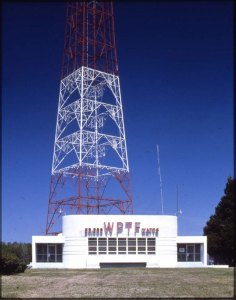
WTPF’s former site: A “Time Capsule from the 1940’s”

(Source: ABC11.com via Mike Hansgen)

Photo source: WTPF.com

The distinct Art Deco style clearly defines the WPTF radio station as a 1940’s classic.

With rounded windows and curved edges, the building looks tiny on the outside, but cuts deep underground into a shelter that allowed announcers to broadcast through wars and hurricanes.

Today, it’s hidden behind tall shrubs, a chain-link fence, and a set of train tracks – it often goes unnoticed, a relic from a long past era of Raleigh history.

Decades ago, this station was staffed 24-hours a day, which means it provides amenities like a kitchen and shower. However, this enticing building has been closed to the public, mostly forgotten, for decades. Nearly 80 years old and sealed to most of the outside world, it harbors dust-coated secrets that time forgot, like a living time capsule.[…]

Click here to read the full article and view photos of the site.

Also, check out the following photos of WTPF courtesy of this imgur.com account:

Former WPTF 680 AM art deco studio – Cary, NC

//s.imgur.com/min/embed.js

from toptenrss https://ift.tt/2HmgZqE
via IFTTT

Video: Russian numbers station on the 19 meter band

Many thanks to SWLing Post contributor, Moshe, for sharing the following video:

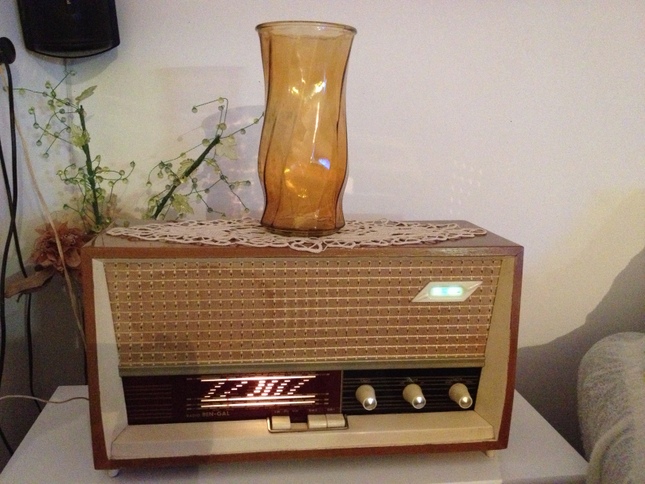
I uploaded this video I made in a rush, holding our baby in one hand and my smartphone in the other one…

The receiver is my Ben-Gal Verdi.

I caught the station by accident, while tuning to VOA 15580kHz to listen to Boarder Crossings.

Click here to view on YouTube.

Fantastic catch, Moshe! Thank you for sharing. I can’t tell you how many times in the past I played radio while also holding a baby in my arms. Always a challenge!

from toptenrss https://ift.tt/2qS7Ajz
via IFTTT

IOTA News from OPDX

QRZ Callsign Search
Page last updated on: Sunday, April 22, 2018

IOTA News from OPDX

23 April , 2018

Island activities:

AS-073. Luca, IK2PFL, will once again be active as 9M2/IK2PFL from Perhentian Kecil Island. This time during the RSGB IOTA Contest (July 28-29th) as a Single-Op/Island-DXpedition entry.
Activity outside of the contest will be holiday style on 30-10 meters
(possibly 40m) with a focus on the 30/17/12 meters using mainly CW.
QSL via IK2PFL, direct or by the Bureau. For more details and updates, see: http://www.stellemare.eu/wordpress/amateur-radio

AS-201. Operators Ben/DL7UCX and Bernd/DL7VBJ are now active as TA0/DL7UCX TA0/DL7VBJ from Marmara Island until April 26th. Activity will
be on various HF Bands. QSL TA0/DL7UCX via DL7UCX or LoTW.
QSL TA0/DL7VBJ via DL7VBJ.

AS-201. DX-World team members (Col/MM0NDX, Max/IK8LOV, Björn/ON9CFG) will undertake their inaugural DXpedition to Buyukada Island, Turkey, between May 7-11th. Operating as TC0AX, they will be
active holiday style on 80-2 meters, focusing on being happy and enjoying themselves with a view to contacting as many readers and friends of DX-World Web site as possible. QSL via M0SDV or LoTW. Logs will be uploaded to ClubLog.

EU-065. Jérôme, F4HJO, will be active as F4HJO/P from the Island of
Ushant (DIFM AT001) between April 28th and May 4th. Activity will be on 80-17 meters using SSB and the Digital modes. QSL via his home callsign, direct, by the Bureau, ClubLog or LoTW.

NA-013. Operators Sergey/R4WAA, YL Elena/RC5A, Yan/RZ3FW and Yuri/RM0F, members of the Russian Robinson Club, will be active as H7/R4WAA H7/RC5A, H7/RZ3FW, H7/RM0F and YN4RRC from Big Corn Island between November 26th and December 26th. Activity will be on
160-10 meters using CW and SSB. Listen for QSL routes.

NA-071. (Update) Members of the V.R.I. Association will be active as
3F6IC from Cebaco Island between May 4-6th. Operators mentioned are Victor/HP1AVS, Henry/HP1CDW, Enrique/HP1ECA, Roberto/HP1MRA,
Romel/HP8MAK and HP1JGG. Activity will be on 80-10 meters, including 60 meters (5.357 MHz between 2230-2359z on May 4th and 5th), and using SSB and the Digital modes. QSL via HP1AVS.

PLEASE NOTE: Since the Webmasters of the new <www.iota-world.org> have decided NOT to post or dedicate a Web page to announce upcoming IOTA operations, PLEASE send your IOTA operations information to the OPDX and we will post it here in an upcoming bulletin……

Check-out the latest IOTA News from the Deutscher Amateur Radio Club

Share this information !
Follow us

Delivered by FeedBurner

Daily solar report: Current Sunspot Cycle 24 Activity and Space…

Daily solar report: Current Sunspot Cycle 24 Activity and Space Weather

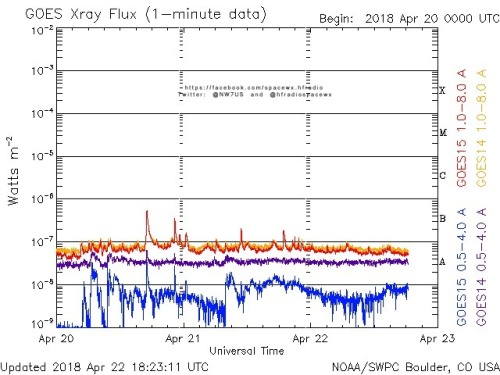
Sunspot count: Sun Spots: 34 as of 04/21/2018
10.7-cm Radio Flux: 77 SFU (SFU=Solar Flux Units)
Estimated Planetary A-index (Ap): 12 | K-index (Kp): 1

Solar Wind: 453 km/s at 6.0 protons/cm3, Bz is -2.0 nT
(Apr 22, 2018 at 1812 UT)

X-ray Solar Flares:
6h hi [B2.0][1045Z 04/21] 24h hi [B2.0][1045Z 04/21]

Background X-ray Level, Last Six Days

Apr 21 2018 :: A6.2
Apr 20 2018 :: A5.7
Apr 19 2018 :: A3.7
Apr 18 2018 :: A2.7
Apr 17 2018 :: A1.6
Apr 16 2018 :: A1.5

Global HF Propagation Conditions for 1800Z on 22 Apr, 2018
High Latitude: Normal
Middle Latitude: Normal
Low Latitude: Normal

Geomagnetic Latitude Ranges: High: 60-90 degrees, Middle: 20-60 degrees, Low: 0-20 degrees

For live data and images, visit http://SunSpotWatch.com

This report has been prepared by your space weather and radio propagation reporter, Tomas ( amateur radio operator, NW7US, http://NW7US.us )

Check out the stunning view of our Sun in action, as seen during the last five years with the Solar Dynamics Observatory (SDO):
https://www.youtube.com/watch?v=zXN-MdoGM9g

= = = =

BOOK SALE: Space Weather and Sun Science – get these from Amazon, and help us stay online!

NOTICE: When you buy this (or any item after starting with this link), you are helping us keep our SunSpotWatch.com and other resources “on the air” (up and running!). In other words, you are helping the entire community. So, check out this book:

Here is the link to Amazon:
http://g.nw7us.us/fbssw-aSWSC

= = = =

Don’t forget: You can also get the space weather and radio propagation self-study course, today. Visit http://nw7us.us/swc for the latest sale and for more information!

= = = =

Visit our live space weather and radio propagation web site, at: http://SunSpotWatch.com

See the live aurora mapping is at http://aurora.sunspotwatch.com

If you are on Twitter, please follow these two users:

1) https://Twitter.com/NW7US
2) https://Twitter.com/hfradiospacewx

We’re on Facebook: http://NW7US.us/swhfr

from toptenrss https://ift.tt/2HG5VZ6
via IFTTT

C96RRC C98RRC Mozambique Island Inhaca Island. From DXNews.com

Radio Amateurs members of Russian Robinson Club will be active as C96RRC and C98RRC from Mozambique Island, IOTA AF – 088 and Inhaca Island, IOTA AF – 066.

from toptenrss https://ift.tt/2CjvtJs
via IFTTT

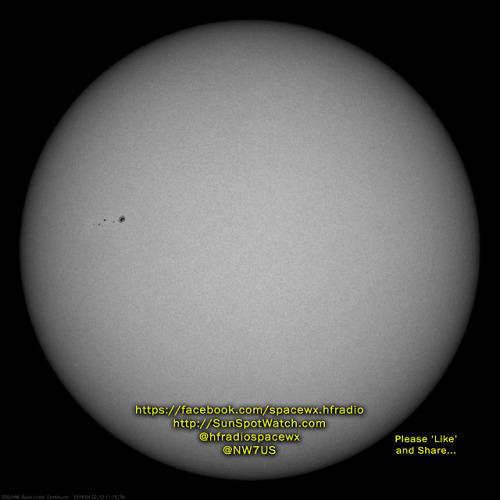
Today’s Sun, seen through a filter of…

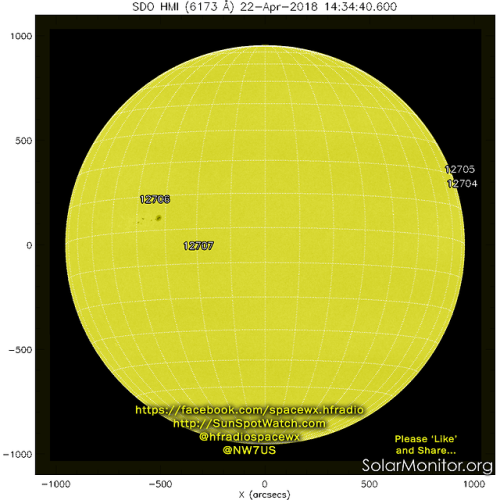
Today’s Sun, seen through a filter of ‘visible’ light (remember: NEVER look directly at the Sun!), as viewed by the Solar Dynamics Observatory (SDO), by the Helioseismic Magnetic Imager (HMI). This image is known as a ‘continuum’ image; a continuum image is formed by filtering portions of the visible light part of the spectrum. The SDO HMI is designed to study oscillations and the magnetic field at the solar surface, or photosphere.

The continuum images allow us to track the evolution of sunspots. These images are important as they allow us to better understand the dynamic nature of the solar atmosphere.

= = = = = =

BOOK SALE: Space Weather and Sun Science – get these from Amazon, and help us stay online!

NOTICE: When you buy this (or any item after starting with this link), you are helping us keep our SunSpotWatch.com and other resources “on the air” (up and running!). In other words, you are helping the entire community. So, check out this book:

Here is the link to Amazon:
http://g.nw7us.us/fbssw-aSWSC

= = = = = =

Visit our live space weather and radio propagation web site, at: http://SunSpotWatch.com

See the live aurora mapping is at http://aurora.sunspotwatch.com

We’re on Facebook: http://NW7US.us/swhfr

Twitter feeds:
https://Twitter.com/NW7US and https://Twitter.com/hfradiospacewx

from toptenrss https://ift.tt/2HlnQ3A
via IFTTT

Grimeton Radio / SAQ LF transmitter on the air May 1, 2018

Alexanderson alternator in the SAQ Grimeton VLF transmitter.

(Source: ARRL via Mike Hansgen)

Low-frequency World Heritage Grimeton Radio Station, SAQ, will transmit from Sweden on May 1 as participation in the European Route of Industrial Heritage’s “Work It Out” observance.

“As part of the event, we plan for the first SAQ transmission since 2016,” said Lars Kalland, SM6NM. The transmitter start-up will begin at 0930 UTC, with the transmission to follow on 17.2 kHz CW at 1000 UTC.

A live video stream of the event will be available. Kalland said no QSL cards will sent, nor will SAQ post a list of reports, but SAQ does invite brief listener reports via e-mail.

“We sincerely hope that all the SAQ transmission on 17.2 kHz will go as planned,” Kalland said. “But, as always, there is a reservation that the transmission [may be] cancelled on short notice.”

Click here to read on the ARRL website.

from toptenrss https://ift.tt/2HRUrPI
via IFTTT

WTPF’s former site: A “Time Capsule from the 1940’s”

(Source: ABC11.com via Mike Hansgen)

Photo source: WTPF.com

The distinct Art Deco style clearly defines the WPTF radio station as a 1940’s classic.

With rounded windows and curved edges, the building looks tiny on the outside, but cuts deep underground into a shelter that allowed announcers to broadcast through wars and hurricanes.

Today, it’s hidden behind tall shrubs, a chain-link fence, and a set of train tracks – it often goes unnoticed, a relic from a long past era of Raleigh history.

Decades ago, this station was staffed 24-hours a day, which means it provides amenities like a kitchen and shower. However, this enticing building has been closed to the public, mostly forgotten, for decades. Nearly 80 years old and sealed to most of the outside world, it harbors dust-coated secrets that time forgot, like a living time capsule.[…]

Click here to read the full article and view photos of the site.

Also, check out the following photos of WTPF courtesy of this imgur.com account:

Former WPTF 680 AM art deco studio – Cary, NC

//s.imgur.com/min/embed.js

from toptenrss https://ift.tt/2HmgZqE
via IFTTT

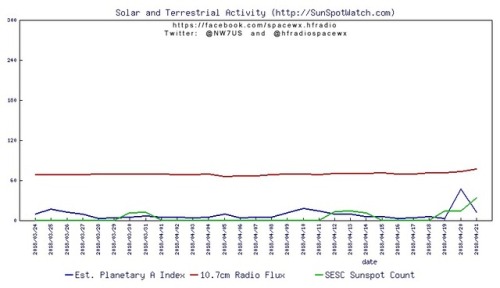
Today’s graph, plotting the SESC sunspot number, the…

Today’s graph, plotting the SESC sunspot number, the 10.7cm Radio Flux, and the Estimated Planetary A Index, for the last 30 days.

The numbers are:


   Date    | Sunspots | 10.7-cm Flux |  Ap 
==========================================
2018/04/21 |     34   |     77       |  12
2018/04/20 | 14 | 73 | 47
2018/04/19 | 14 | 71 | 3
2018/04/18 | 0 | 71 | 6
2018/04/17 | 0 | 69 | 4
2018/04/16 | 0 | 69 | 3
2018/04/15 | 0 | 71 | 6
2018/04/14 | 11 | 70 | 6
2018/04/13 | 14 | 70 | 9
2018/04/12 | 13 | 70 | 9
2018/04/11 | 0 | 68 | 14
2018/04/10 | 0 | 69 | 18
2018/04/09 | 0 | 69 | 11
2018/04/08 | 0 | 68 | 5
2018/04/07 | 0 | 67 | 5
2018/04/06 | 0 | 67 | 4
2018/04/05 | 0 | 66 | 9
2018/04/04 | 0 | 69 | 5
2018/04/03 | 0 | 68 | 4
2018/04/02 | 0 | 68 | 5
2018/04/01 | 0 | 69 | 5
2018/03/31 | 12 | 69 | 7
2018/03/30 | 11 | 69 | 5
2018/03/29 | 0 | 69 | 4
2018/03/28 | 0 | 69 | 3
2018/03/27 | 0 | 68 | 9
2018/03/26 | 0 | 68 | 12
2018/03/25 | 0 | 68 | 17
2018/03/24 | 0 | 68 | 9

For complete live data and images visit http://SunSpotWatch.com

Be sure to share this post, to spread the love!

Check out the stunning view of our Sun in action, as seen during the last five years with the Solar Dynamics Observatory (SDO):
https://www.youtube.com/watch?v=zXN-MdoGM9g

-=-=-=-=-=-

What’s the difference between CB & amateur (ham) radio? Here ia a video with an opinion by our curator, Tomas (amateur radio operator, NW7US): Did NCIS TV Show Malign the Amateur Radio Service? https://www.youtube.com/watch?v=pIWJ7kKbxiM?t=1m33s

-=-=-=-=-=-

If you are on Twitter, please follow these two users:

1) https://Twitter.com/NW7US
2) https://Twitter.com/hfradiospacewx

We’re on Facebook: http://NW7US.us/swhfr

from toptenrss https://ift.tt/2HX3RcZ
via IFTTT

DXCC Approved. From DXNews.com

The DXCC Department has approved the following operations

from toptenrss https://ift.tt/2nsVCxD
via IFTTT

V47CDC – St Kitts

Alex, W1CDC will be active from St Kitts & Nevis as V47CDC during April 23 to May 5, 2018. QRV on HF. QSL via H/c.

from toptenrss https://ift.tt/2HRs4RN
via IFTTT

Did you know? Here’s a space weather and radio…

Did you know? Here’s a space weather and radio propagation educational tidbit – from http://SunSpotWatch.com – at 14:00 UTC on 2018-04-22:

The ionosphere is strongly dependent on the condition of the geomagnetic field. Earth’s geomagnetic field wraps around the Earth and the ionosphere. The solar wind drags the geomagnetic field and creates the Earth’s magnetosphere.

Despite its name, the magnetosphere is distinctly non-spherical. Earth’s magnetosphere provides for our protection from the Sun and from space.

The Sun-side of the magnetosphere is compressed toward the Earth. The night-side of the magnetosphere is dragged far out into space away from the Sun. The magnetosphere’s shape is kind of like that of a comet, facing the Sun.

= = = =

What’s the difference between CB & amateur (ham) radio? Here ia a video with an opinion by our curator, Tomas (amateur radio operator, NW7US): Did NCIS TV Show Malign the Amateur Radio Service? https://www.youtube.com/watch?v=pIWJ7kKbxiM?t=1m33s

= = = =

If you are on Twitter, please follow these two users:

1) https://Twitter.com/NW7US
2) https://Twitter.com/hfradiospacewx

..

from toptenrss https://ift.tt/2HkMYf9
via IFTTT

Video: Russian numbers station on the 19 meter band

Many thanks to SWLing Post contributor, Moshe, for sharing the following video:

I uploaded this video I made in a rush, holding our baby in one hand and my smartphone in the other one…

The receiver is my Ben-Gal Verdi.

I caught the station by accident, while tuning to VOA 15580kHz to listen to Boarder Crossings.

Click here to view on YouTube.

Fantastic catch, Moshe! Thank you for sharing. I can’t tell you how many times in the past I played radio while also holding a baby in my arms. Always a challenge!

from toptenrss https://ift.tt/2qS7Ajz
via IFTTT

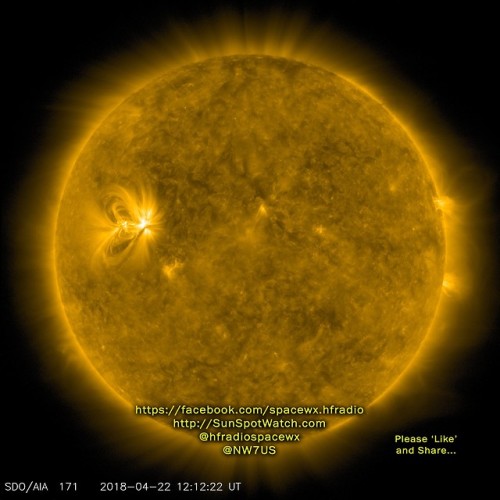
Today’s Sun (artificially-colored in yellow) seen at the…

Today’s Sun (artificially-colored in yellow) seen at the 171-angstrom wavelength (Extreme Ultraviolet, or EUV), as viewed by the Solar Dynamics Observatory (SDO), by the Atmospheric Imaging Assembly (AIA).

At this wavelength, at a wavelength not seen by the un-aided eye, we observe the Sun with the 17.1 nm (171 A) filter. This Extreme Ultraviolet (EUV) waveband is used to monitor the corona and upper transition region. With this filter, we can see the myrid of massive magnetic field lines, from simple to complex, that weave and twist throughout the Sun.

The image is a ‘false color image’, meaning that observed data are in a range outside of what human eyes can see, so the data are digitally recast into colors that emphasize physically important features. This view is created from data gathered by the Solar Dynamics Observatory (SDO) satellite that flies above Earth’s atmosphere in an inclined geosynchronous orbit.

Emissions captured in this image come from iron (Fe), a trace element in the solar atmosphere that emits Extreme Ultraviolet (EUV) light when heated to temperatures in excess of one million deg K. In the solar corona the temperatures are so high that most chemical elements have lost many of their electrons. Some of the remaining electrons still attached to the atom emit EUV radiation in narrow wavebands or lines.

The 17.1 nm filter, or channel, is dominated by emissions from highly ionized iron: 8 times ionized (missing 8 electrons) iron–Fe IX. The roman numeral descriptors are consistent with spectral notation: the level of ionization for a given roman numeral is one unit larger that the actual number of missing electrons. The temperatures associated with this level of ionization is about 6 x 10^5 K.

The bright regions in this image correspond to regions of closed magnetic field loops that trap the hot, emitting plasma. Large bright regions are often called active regions. The dark regions correspond to cooler temperatures and possibly to locations where magnetic field lines open into the heliosphere, and thus, do not trap hot plasma.

View live data and images at http://SunSpotWatch.com

= = = =

BOOK SALE: Space Weather and Sun Science – get these from Amazon, and help us stay online!

NOTICE: When you buy this (or any item after starting with this link), you are helping us keep our SunSpotWatch.com and other resources “on the air” (up and running!). In other words, you are helping the entire community. So, check out this book:

Here is the link to Amazon:
http://g.nw7us.us/fbssw-aSWSC

= = = =

Visit our live space weather and radio propagation web site, at: http://SunSpotWatch.com

See the live aurora mapping is at http://aurora.sunspotwatch.com

If you are on Twitter, please follow these two users:

1) https://Twitter.com/NW7US
2) https://Twitter.com/hfradiospacewx

We’re on Facebook: http://NW7US.us/swhfr

from toptenrss https://ift.tt/2K6UVC7
via IFTTT

Latest TEC map from NASA. What is TEC? Total Electron Content…

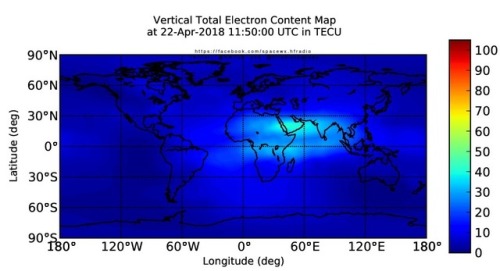
Latest TEC map from NASA. What is TEC? Total Electron Content (or TEC) is an important descriptive quantity for the ionosphere of the Earth. TEC is the total number of free electrons integrated between two points, along a tube of one meter squared cross section, i.e., the electron columnar number density. Affected by solar activity, Total Electron Content (TEC) describes the total number of free electrons present within one square meter between two points (i.e. between the receiver and satellite involved in measuring TEC).

These maps are also used to monitor ionospheric weather, and to nowcast ionospheric storms that often occur responding to activities in solar wind and Earth’s magnetosphere as well as thermosphere.

View live data and images at http://SunSpotWatch.com

Follow: https://Twitter.com/NW7US and https://Twitter.com/hfradiospacewx

Facebook: http://NW7US.us/swhfr

And: Check out the stunning view of our Sun in action, as seen during the last five years with the Solar Dynamics Observatory (SDO):
https://www.youtube.com/watch?v=zXN-MdoGM9g

= = = =

BOOK SALE: Space Weather and Sun Science – get these from Amazon, and help us stay online!

NOTICE: When you buy this (or any item after starting with this link), you are helping us keep our SunSpotWatch.com and other resources “on the air” (up and running!). In other words, you are helping the entire community. So, check out this book:

Here is the link to Amazon:
http://g.nw7us.us/fbssw-aSWSC

= = = =

See the live aurora mapping is at http://aurora.sunspotwatch.com

If you are on Twitter, please follow these two users:

1) https://Twitter.com/NW7US
2) https://Twitter.com/hfradiospacewx

We’re on Facebook: http://NW7US.us/swhfr

from toptenrss https://ift.tt/2HEZEN3
via IFTTT

Latest TEC map from NASA. What is TEC? Total Electron Content…

Latest TEC map from NASA. What is TEC? Total Electron Content (or TEC) is an important descriptive quantity for the ionosphere of the Earth. TEC is the total number of free electrons integrated between two points, along a tube of one meter squared cross section, i.e., the electron columnar number density. Affected by solar activity, Total Electron Content (TEC) describes the total number of free electrons present within one square meter between two points (i.e. between the receiver and satellite involved in measuring TEC).

These maps are also used to monitor ionospheric weather, and to nowcast ionospheric storms that often occur responding to activities in solar wind and Earth’s magnetosphere as well as thermosphere.

View live data and images at http://SunSpotWatch.com

Follow: https://Twitter.com/NW7US and https://Twitter.com/hfradiospacewx

Facebook: http://NW7US.us/swhfr

And: Check out the stunning view of our Sun in action, as seen during the last five years with the Solar Dynamics Observatory (SDO):
https://www.youtube.com/watch?v=zXN-MdoGM9g

= = = =

BOOK SALE: Space Weather and Sun Science – get these from Amazon, and help us stay online!

NOTICE: When you buy this (or any item after starting with this link), you are helping us keep our SunSpotWatch.com and other resources “on the air” (up and running!). In other words, you are helping the entire community. So, check out this book:

Here is the link to Amazon:
http://g.nw7us.us/fbssw-aSWSC

= = = =

See the live aurora mapping is at http://aurora.sunspotwatch.com

If you are on Twitter, please follow these two users:

1) https://Twitter.com/NW7US
2) https://Twitter.com/hfradiospacewx

We’re on Facebook: http://NW7US.us/swhfr

from toptenrss https://ift.tt/2HEZEN3
via IFTTT

Latest TEC map from NASA. What is TEC? Total Electron Content…

Latest TEC map from NASA. What is TEC? Total Electron Content (or TEC) is an important descriptive quantity for the ionosphere of the Earth. TEC is the total number of free electrons integrated between two points, along a tube of one meter squared cross section, i.e., the electron columnar number density. Affected by solar activity, Total Electron Content (TEC) describes the total number of free electrons present within one square meter between two points (i.e. between the receiver and satellite involved in measuring TEC).

These maps are also used to monitor ionospheric weather, and to nowcast ionospheric storms that often occur responding to activities in solar wind and Earth’s magnetosphere as well as thermosphere.

View live data and images at http://SunSpotWatch.com

Follow: https://Twitter.com/NW7US and https://Twitter.com/hfradiospacewx

Facebook: http://NW7US.us/swhfr

And: Check out the stunning view of our Sun in action, as seen during the last five years with the Solar Dynamics Observatory (SDO):
https://www.youtube.com/watch?v=zXN-MdoGM9g

= = = =

BOOK SALE: Space Weather and Sun Science – get these from Amazon, and help us stay online!

NOTICE: When you buy this (or any item after starting with this link), you are helping us keep our SunSpotWatch.com and other resources “on the air” (up and running!). In other words, you are helping the entire community. So, check out this book:

Here is the link to Amazon:
http://g.nw7us.us/fbssw-aSWSC

= = = =

See the live aurora mapping is at http://aurora.sunspotwatch.com

If you are on Twitter, please follow these two users:

1) https://Twitter.com/NW7US
2) https://Twitter.com/hfradiospacewx

We’re on Facebook: http://NW7US.us/swhfr

from toptenrss https://ift.tt/2HEZEN3
via IFTTT